
How to Improve Preventive Maintenance in Indonesian Manufacturing Plants
Why Preventive Maintenance Programs Fail in Indonesian Manufacturing
Proven Strategies to Reduce Equipment Failures, Machine Downtime & Maintenance CostsS
Table of Contents
Manufacturers looking to improve preventive maintenance in Indonesian manufacturing plants need more than a fixed maintenance schedule. An effective preventive maintenance program combines accurate asset information, standardized inspections, automated work orders, spare parts availability, technician accountability, maintenance history, and measurable performance indicators.
For manufacturing plants across Indonesia, where production operations span industries such as food and beverage, automotive, textiles, chemicals, electronics, plastics, metals, pharmaceuticals, and consumer goods, equipment reliability is critical to maintaining production continuity.
A Computerized Maintenance Management System (CMMS) can provide the digital foundation for managing these activities by connecting assets, preventive maintenance schedules, work orders, inspections, spare parts, technicians, and maintenance data in one system.
This guide explains how manufacturing plants in Indonesia can strengthen preventive maintenance, why traditional maintenance programs often fail, and how CMMS, Industrial IoT, condition monitoring, and AI can support a more proactive maintenance strategy.
In This Guide, You'll Learn
- What preventive maintenance means for Indonesian manufacturers
- Why preventive maintenance programs fail
- How to improve preventive maintenance performance
- How CMMS software supports preventive maintenance
- How Industrial IoT enables condition-based maintenance
- Which maintenance KPIs manufacturers should track
- How to choose CMMS software for an Indonesian manufacturing plant
What Is Preventive Maintenance?
Preventive maintenance is a planned maintenance strategy in which equipment is inspected, serviced, adjusted, calibrated, or replaced at predetermined intervals to reduce the likelihood of unexpected equipment failure.
Instead of waiting for a machine to break down, maintenance teams perform specific activities before failure occurs.
Preventive maintenance can be scheduled according to:
- Calendar intervals
- Equipment runtime
- Production cycles
- Meter readings
- Manufacturer recommendations
- Asset criticality
- Historical failure patterns
For example, a manufacturing plant may schedule:
- Motor inspections every month
- Lubrication based on operating hours
- Pump inspections every 500 operating hours
- Electrical panel inspections quarterly
- Compressor servicing based on runtime
- Equipment calibration at defined intervals
The objective is straightforward:
Prevent avoidable equipment failures before they disrupt production.

Why Is Preventive Maintenance Important for Indonesian Manufacturing Plants?
Indonesia has a diverse manufacturing sector, with production facilities operating across industries such as food and beverage, automotive, textiles and apparel, chemicals, pharmaceuticals, electronics, plastics, metals, and consumer products.
These facilities often depend on interconnected production equipment, utilities, material-handling systems, and supporting infrastructure. A failure in one critical asset can affect downstream processes, production schedules, product quality, labor utilization, and delivery commitments.
For example:
Motor failure → Production line stops → Emergency maintenance → Delayed production → Higher maintenance cost
A structured preventive maintenance program helps break this cycle by identifying maintenance requirements before equipment reaches a critical failure condition.
Manufacturers can use preventive maintenance to:
- Reduce unplanned downtime
- Improve equipment availability
- Extend asset life
- Reduce emergency maintenance
- Improve technician productivity
- Improve spare parts planning
- Increase maintenance visibility
- Support consistent production
- Improve equipment reliability
For plants managing hundreds or thousands of assets, however, achieving these outcomes manually becomes increasingly difficult.
That is where digital maintenance management becomes important
Maintenance Challenges Faced by Manufacturing Plants in Indonesia
Preventive maintenance programs can be affected by several operational challenges. These challenges become more significant as plants expand their asset base, production lines, facilities, and maintenance teams.
Manual Maintenance Processes
Spreadsheets, paper forms, emails, and messaging applications can make it difficult to maintain a single source of truth for maintenance activities.
Teams may struggle to determine:
- Which PM tasks are due
- Which tasks are overdue
- Who is responsible
- What maintenance was previously performed
- Which assets require additional attention
As the number of production assets increases, manually managing maintenance activities becomes harder to control.
Production and Maintenance Priorities
Scheduled maintenance can be postponed when production demands are high or when technicians are occupied with unexpected breakdowns.
Repeatedly postponing preventive maintenance can eventually increase equipment deterioration and the risk of unplanned failure.
Multiple Plants and Locations
Manufacturing organizations operating multiple facilities may need centralized visibility while still allowing individual plants or maintenance teams to manage local work.
A digital maintenance platform can help standardize maintenance processes across locations while maintaining asset-level information for each facility
Spare Parts Availability
Preventive maintenance can also be delayed when required components are unavailable.
Critical bearings, seals, filters, lubricants, electrical components, and other spare parts should be planned alongside scheduled maintenance activities.
Inconsistent Maintenance Procedures
Different technicians may inspect the same equipment differently if standardized procedures and checklists are not available.
Digital checklists can help ensure that important inspection points are completed consistently and that maintenance records are captured for future reference.
Why Do Preventive Maintenance Programs Fail?
Having a preventive maintenance schedule does not automatically mean a plant has an effective maintenance program.
Maintenance performance can deteriorate when schedules, asset information, inspections, inventory, and work execution are managed separately.
1. Maintenance Is Still Managed Manually
Many maintenance teams continue to rely on spreadsheets, paper forms, emails, or messaging applications.
As the number of production assets increases, manually managing maintenance activities becomes harder to control.
A digital maintenance system can provide a centralized view of maintenance tasks and asset history.
2. Preventive Maintenance Schedules Are Not Followed
A PM schedule may exist but still fail in execution.
Common reasons include:
- Production priorities
- Technician availability
- Manual reminders
- Emergency breakdowns
- Poor maintenance planning
- Lack of management visibility
Tracking PM compliance digitally helps maintenance managers identify overdue work and understand whether planned maintenance is actually being completed.
3. Asset Information Is Incomplete
Preventive maintenance depends on accurate asset information.
Maintenance teams should have access to:
- Asset name
- Asset ID
- Location
- Equipment type
- Manufacturer
- Model
- Maintenance frequency
- Failure history
- Criticality
- Associated spare parts
- Maintenance procedures
Without a centralized asset register, technicians may not have a complete understanding of the maintenance requirements of each machine.
4. Maintenance Checklists Are Not Standardized
Two technicians may inspect the same machine differently.
One technician may check vibration, lubrication, temperature, and unusual noise, while another may only verify the basic operating condition.
Digital maintenance checklists can standardize inspection procedures and ensure critical inspection points are not missed.
5. Spare Parts Are Not Available When Needed
A scheduled maintenance task may be delayed when required spare parts are unavailable.
Connecting preventive maintenance with spare parts management helps maintenance teams verify inventory requirements before maintenance begins.
6. Maintenance Data Is Not Analyzed
Every completed maintenance task creates valuable operational data.
However, if maintenance history is simply stored and never analyzed, manufacturers may miss recurring problems.
For example:
Pump failure → Repair → Pump failure again → Repair again
Repeated failures may indicate an incorrect maintenance interval, an underlying equipment problem, poor operating conditions, or an unresolved root cause.
Maintenance analytics can help teams identify these patterns and improve preventive maintenance strategies.
10 Ways to Improve Preventive Maintenance in Indonesian Manufacturing Plants
1. Create a Risk-Based Preventive Maintenance Program
Not every machine requires the same maintenance priority.
To improve preventive maintenance performance, manufacturers should classify assets according to their operational and business impact.
Consider:
- Production impact
- Safety risk
- Failure frequency
- Repair cost
- Replacement cost
- Product quality impact
- Availability of backup equipment
High-criticality assets should receive greater maintenance attention than assets with limited production impact.
This risk-based approach helps maintenance teams allocate technicians, spare parts, and maintenance resources where they can deliver the greatest reliability improvement.
2. Digitize Preventive Maintenance With a CMMS
One of the most effective ways to improve preventive maintenance is to move from disconnected spreadsheets and paper-based processes to a centralized CMMS.
A CMMS can connect:
Assets + PM Schedules + Work Orders + Technicians + Checklists + Spare Parts + Maintenance History + KPIs
Instead of manually tracking maintenance schedules, teams can use a CMMS to:
- Create recurring PM schedules
- Automatically generate work orders
- Assign technicians
- Set maintenance priorities
- Track task completion
- Record inspection findings
- Attach photos and documents
- Maintain asset history
- Monitor overdue maintenance
For organizations operating multiple production lines or facilities, centralized maintenance data can make preventive maintenance easier to standardize and scale.
3. Build Asset-Based Maintenance Schedules
Preventive maintenance should be connected directly to individual assets.
For each critical asset, define:
Asset → Maintenance Task → Frequency → Technician → Checklist → Spare Parts → Completion Record
For example:
Industrial Air Compressor
Asset: Compressor-001
PM Frequency: Monthly
Inspection: Pressure, temperature, vibration, oil level
Checklist: Digital compressor inspection checklist
Parts: Filters, seals, lubricants
Responsible Team: Maintenance technician
This structure creates a repeatable maintenance workflow and makes the maintenance history of each asset easier to track.
4. Use Digital Maintenance Checklists
Digital checklists help technicians execute preventive maintenance consistently.
A checklist can include:
- Inspection points
- Acceptable operating ranges
- Pass/fail conditions
- Measurement fields
- Safety checks
- Photos
- Technician comments
- Corrective actions
Instead of relying on memory or paper forms, technicians can follow the same inspection procedure every time.
This becomes particularly valuable when different technicians or shifts maintain the same production equipment.
5. Connect Spare Parts With Preventive Maintenance
A preventive maintenance task is only useful if technicians have the resources required to complete it.
A CMMS can help maintenance teams:
- Link spare parts to assets
- Track inventory levels
- Set minimum stock levels
- Monitor consumption
- Identify critical parts
- Generate low-stock alerts
- Record parts used during work orders
For example, before scheduling major pump maintenance, the maintenance team can verify whether required bearings, seals, filters, or lubricants are available.
This reduces delays caused by missing components.
6. Track Preventive Maintenance Compliance
A preventive maintenance program should be measured.
One of the most important indicators is PM Compliance.
PM Compliance Formula
PM Compliance = Completed PM Tasks ÷ Scheduled PM Tasks × 100
For example:
If 100 PM tasks were scheduled and 92 were completed on time:
PM Compliance = 92%
Tracking this metric helps maintenance managers determine whether preventive maintenance is being executed according to plan.
A consistently low PM compliance rate may indicate scheduling problems, technician capacity constraints, production conflicts, or ineffective maintenance planning.
7. Track MTBF and MTTR
Preventive maintenance should ultimately improve equipment reliability.
Two important maintenance metrics are MTBF and MTTR.
Mean Time Between Failures
MTBF = Total Operating Time ÷ Number of Failures
A higher MTBF generally indicates improved equipment reliability.
Mean Time To Repair
MTTR = Total Repair Time ÷ Number of Repairs
A lower MTTR generally indicates that maintenance teams are restoring equipment faster.
Tracking both metrics provides a broader view of maintenance performance.
For example, if PM compliance increases but MTBF does not improve, the maintenance team may need to investigate whether the current PM tasks and intervals are actually addressing the underlying failure modes.
8. Use Equipment Condition Monitoring
Traditional preventive maintenance operates according to predefined schedules.
However, equipment condition can change between scheduled maintenance activities.
Industrial IoT sensors can monitor parameters such as:
- Vibration
- Temperature
- Pressure
- Energy consumption
- Motor current
- Runtime
- Operating conditions
This enables maintenance teams to identify abnormal conditions earlier.
The maintenance strategy can gradually evolve from:
Reactive → Preventive → Condition-Based → Predictive
For critical equipment, integrating IoT data with maintenance workflows can help teams move from simply following schedules toward responding to actual equipment conditions.
9. Use Maintenance History to Improve PM Schedules
Preventive maintenance schedules should not remain unchanged forever.
Manufacturers should regularly review maintenance history to determine:
- Which assets fail frequently?
- Which components fail repeatedly?
- Which PM tasks prevent failures?
- Which tasks are unnecessary?
- Which maintenance intervals should change?
- Which assets require additional monitoring?
For example, if a motor repeatedly experiences bearing failures before its scheduled inspection, the maintenance interval may need to be reviewed.
This creates a continuous improvement cycle:
Maintenance Data → Analysis → PM Optimization → Better Reliability
The goal is to continuously improve the maintenance strategy rather than simply complete more maintenance tasks.
10. Use AI to Move Toward Predictive Maintenance
Once maintenance teams have centralized asset, work order, inspection, and equipment data, AI can provide additional insights.
AI-powered maintenance systems can help:
- Identify high-risk assets
- Detect abnormal equipment behavior
- Identify recurring failure patterns
- Prioritize maintenance activities
- Support predictive maintenance
- Improve maintenance planning
- Recommend maintenance actions
Preventive Maintenance vs Predictive Maintenance
| Preventive Maintenance | Predictive Maintenance |
|---|---|
|
Based on predefined schedules |
Based on equipment condition |
|
Uses time, runtime, or production cycles |
Uses equipment and operational data |
|
Prevents known failure modes |
Identifies developing problems |
|
Easier to implement |
Requires monitoring and data |
|
Provides a strong maintenance foundation |
Supports a more advanced maintenance strategy |
A practical strategy is to combine both approaches:
Preventive Maintenance + Condition Monitoring + AI = More Proactive Maintenance
Preventive maintenance can handle known maintenance requirements, while condition monitoring and predictive technologies can provide additional insight into equipment that behaves differently between scheduled maintenance activities.
How CMMS Software Improves Preventive Maintenance in Indonesia
A CMMS provides the digital infrastructure needed to manage preventive maintenance across manufacturing assets.
Instead of maintaining separate spreadsheets for equipment, maintenance schedules, spare parts, and work orders, a CMMS can connect these activities into one maintenance workflow.
A manufacturing CMMS can help maintenance teams:
Automate PM Scheduling
Automatically generate recurring preventive maintenance work orders based on time, runtime, meter readings, or defined conditions.
Improve Work Order Management
Assign maintenance tasks to technicians and track their status from creation through completion.
Centralize Asset History
Maintain records of inspections, repairs, failures, spare parts, and maintenance activities for each asset.
Improve Technician Productivity
Give technicians access to maintenance tasks, asset information, checklists, and work instructions through mobile devices.
Improve Spare Parts Availability
Connect maintenance activities with spare parts and inventory information.
Track Maintenance KPIs
Monitor PM compliance, MTBF, MTTR, OEE, asset availability, downtime, and maintenance backlog.
For manufacturing organizations, the value of a CMMS is therefore not simply digital work orders. It is the ability to connect the complete maintenance process.
How Fogwing CMMS Supports Preventive Maintenance
Fogwing CMMS provides a centralized maintenance management platform for organizations looking to connect preventive maintenance, assets, work orders, inspections, spare parts, technicians, and maintenance performance.
Fogwing supports preventive maintenance scheduling at the asset level, including recurring schedules and checklist-based execution. Its preventive maintenance workflow can also generate maintenance work orders from scheduled PM activities.
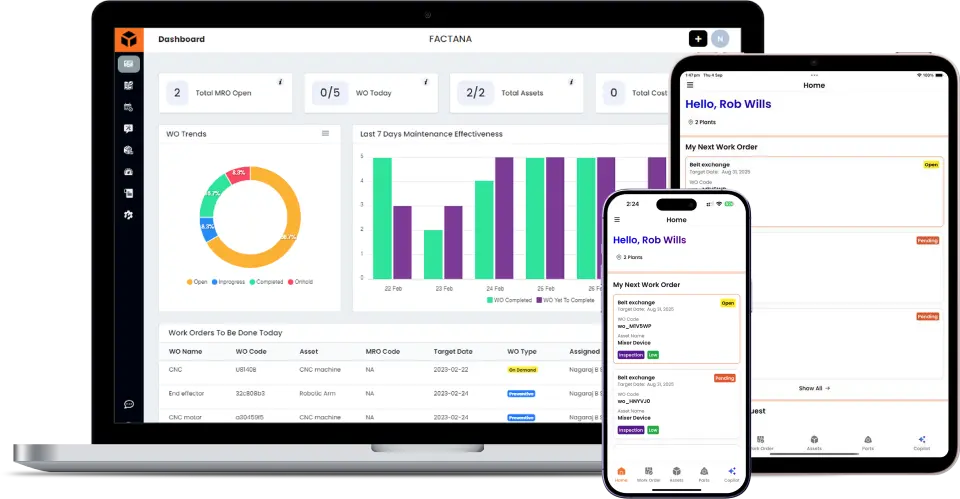
The platform can support connected maintenance activities such as:
- Preventive maintenance management
- Digital work order management
- Asset management
- Digital inspection checklists
- Spare parts and inventory management
- Mobile maintenance workflows
- Industrial IoT integration
- Maintenance dashboards and reporting
- Multi-plant maintenance management
Fogwing also supports condition-based preventive maintenance through IoT data such as vibration, temperature, pressure, runtime, and energy parameters, allowing maintenance actions to be connected with actual asset conditions where appropriate.
The key advantage for a manufacturing organization is the ability to bring maintenance activities into a connected workflow:
Plan → Schedule → Execute → Record → Analyze → Improve
For example, a maintenance manager can define a PM schedule for a critical compressor, generate the associated work order, assign the task to a technician, provide a digital checklist, record inspection results, and retain the completed activity as part of the asset’s maintenance history. Fogwing’s documentation specifically supports PM scheduling, checklist selection, work-order generation, and PM work-order tracking.
When equipment data is also available through Industrial IoT integration, maintenance teams can combine scheduled maintenance with condition-based information.
The objective is not simply to digitize maintenance paperwork. The objective is to create a maintenance operation that continuously improves equipment reliability.

What Should Indonesian Manufacturers Look for in a CMMS?
If the objective is to improve preventive maintenance in Indonesian manufacturing environment, selecting a CMMS based only on work order functionality is not enough.
Manufacturers should evaluate the complete maintenance workflow.
Essential CMMS Capabilities
Asset Management
- Asset hierarchy
- Asset history
- Asset criticality
- Locations
- Equipment information
Preventive Maintenance
- Calendar-based PM
- Meter-based PM
- Recurring schedules
- Automated work orders
- PM compliance tracking
Work Order Management
- Work requests
- Work order assignment
- Priorities
- Status tracking
- Labor tracking
- Failure codes
Digital Checklists
- Inspection procedures
- Measurement fields
- Pass/fail conditions
- Photos
- Technician comments
Spare Parts Management
- Inventory levels
- Parts consumption
- Asset-part relationships
- Low-stock alerts
Mobile CMMS
Technicians should be able to access maintenance activities directly from the production floor or field.
Industrial IoT Integration
For critical equipment, IoT integration can provide real-time machine condition information.
AI-Powered Maintenance
AI can help identify risks, recognize maintenance patterns, and support the transition toward predictive maintenance.
Multi-Plant Management
Organizations operating multiple manufacturing facilities should be able to maintain centralized visibility while managing maintenance activities at individual plants.
A Practical Framework to Improve Preventive Maintenance in Indonesian Manufacturing
Manufacturing organizations in Indonesia can use this five-step framework to strengthen their maintenance program.
Step 1: Identify Critical Assets
Determine which machines have the greatest production, safety, quality, and financial impact.
Step 2: Define Maintenance Requirements
Create preventive maintenance schedules, inspection procedures, checklists, and spare parts requirements.
Step 3: Digitize Maintenance
Use a CMMS to manage assets, PM schedules, work orders, technicians, inspections, and maintenance history.
Step 4: Monitor Equipment Condition
Use Industrial IoT and condition monitoring for critical equipment where real-time equipment data can provide additional maintenance insight.
Step 5: Optimize With Data
Analyze PM compliance, MTBF, MTTR, downtime, failure history, and maintenance costs to continuously improve maintenance strategies.
This creates a practical progression:
Critical Assets → Structured PM → Digital Maintenance → Condition Monitoring → Data-Driven Optimization
Preventive Maintenance Checklist for Indonesian Manufacturing Plants
Use this checklist to evaluate your current maintenance program:
- Create a complete digital asset register
- Classify assets based on criticality
- Define preventive maintenance schedules for critical assets
- Digitize preventive maintenance work orders
- Standardize maintenance procedures with digital checklists
- Track PM compliance
- Record equipment failure history
- Monitor MTBF and MTTR
- Maintain critical spare parts inventory
- Link spare parts with assets and maintenance tasks
- Train technicians on preventive maintenance procedures
- Give technicians mobile access to maintenance tasks
- Monitor critical equipment conditions
- Integrate Industrial IoT where appropriate
- Review recurring failures
- Optimize PM frequencies using maintenance data
- Evaluate AI-powered predictive maintenance for critical assets
How to Build a More Reliable Maintenance Program
Improving preventive maintenance is not a one-time implementation project. It is an ongoing process.
Manufacturers should periodically review:
- Asset criticality
- PM completion rates
- Recurring equipment failures
- Maintenance costs
- Spare parts consumption
- Technician workload
- Equipment condition
- Downtime trends
- MTBF and MTTR
- Maintenance intervals
The results can then be used to adjust preventive maintenance schedules, improve inspection procedures, identify recurring failure modes, and determine where condition monitoring or predictive maintenance could provide additional value.
This continuous improvement approach helps organizations move from maintenance based primarily on schedules toward maintenance informed by actual equipment performance.
Why Trust This Guide?
Effective preventive maintenance combines structured maintenance practices with digital tools that improve visibility and execution.
For manufacturing plants in Indonesia, this means creating a maintenance environment where asset information, preventive maintenance schedules, work orders, inspections, spare parts, equipment data, and maintenance KPIs can work together.
The objective is to move beyond reactive breakdown repair and build a structured maintenance operation that improves equipment reliability, maintenance visibility, and production uptime
Conclusion
To improve preventive maintenance in Indonesian manufacturing plants, manufacturers need more than maintenance calendars.
They need a connected approach that combines:
Critical Asset Management + Preventive Maintenance + Digital Checklists + Spare Parts Management + CMMS + Equipment Monitoring + Maintenance Analytics
A CMMS provides the digital foundation for managing this process by connecting assets, maintenance schedules, work orders, technicians, spare parts, inspections, and maintenance history.
Industrial IoT can provide additional visibility into equipment condition, while AI and predictive maintenance capabilities can help identify emerging risks and recurring failure patterns.
For Indonesian manufacturers looking to modernize maintenance operations, Fogwing CMMS provides a connected platform for preventive maintenance, asset management, work orders, spare parts, Industrial IoT data, and maintenance insights.
The objective is simple: Prevent failures before they stop production.

FAQs
1. How can Indonesian manufacturers improve preventive maintenance?
Manufacturers can improve preventive maintenance by prioritizing critical assets, digitizing PM schedules with a CMMS like Fogwing CMMS, standardizing inspections, improving spare parts availability, tracking PM compliance, monitoring equipment condition, and analyzing maintenance history.
2. How does CMMS improve preventive maintenance?
A CMMS can automate preventive maintenance schedules, generate work orders, assign technicians, manage digital checklists, maintain asset history, manage spare parts, and provide maintenance performance data.
3. What is the difference between preventive and predictive maintenance?
Preventive maintenance schedules maintenance at predetermined intervals, while predictive maintenance uses equipment condition and operational data to identify potential failures before they occur. Manufacturers can use both approaches together to improve equipment reliability.
4. What maintenance KPIs should Indonesian manufacturers track?
Important maintenance KPIs include PM compliance, MTBF, MTTR, OEE, asset availability, unplanned downtime, maintenance backlog, repeat failure rate, and emergency maintenance percentage.
5. What should Indonesian manufacturers look for when choosing CMMS software?
Indonesian manufacturers should look for asset management, preventive maintenance scheduling, work order management, digital checklists, spare parts management, mobile access, maintenance analytics, Industrial IoT integration, workflow automation, AI capabilities, and multi-plant support.