
Best CMMS Software in Philippines for Manufacturing | 2026 Guide
Top CMMS Providers in Philippines
The 2026 Guide for Manufacturing, Food, and Industrial Plants
Table of Contents
Running a manufacturing or food processing operation in the Philippines is tough. Whether it’s tuna processing in General Santos, beverages in Laguna, metal fabrication in Cavite, or packaging lines in Bulacan one thing never changes: equipment downtime is your biggest risk.
Production must stay continuous. Quality audits must be airtight. Compliance with DOLE, FDA Philippines, GMP, HACCP, and ISO standards can’t slip. Yet a single unexpected breakdown can disrupt shipments, spoil raw materials, and inflate operating costs.
This is why more Filipino manufacturers especially food, beverage, seafood, and FMCG are now turning to CMMS tools to keep their equipment reliable and their operations audit-ready.
Maintenance Challenges Driving CMMS Adoption in the Philippines
1. Food Processing Plants Face Strict Audit Pressure
Food and beverage manufacturers in the Philippines must maintain detailed maintenance and sanitation records to comply with FDA Philippines, HACCP, GMP, and export requirements. Missing calibration logs or incomplete maintenance records can delay audits and affect production approvals.
2. Unplanned Downtime Creates Major Production Losses
Many factories still rely on reactive maintenance or spreadsheet-based tracking. When critical assets like fillers, conveyors, chillers, or compressors fail unexpectedly, production delays can quickly affect delivery schedules and operating costs.
3. Humidity and Heat Increase Equipment Stress
The Philippines’ hot and humid climate accelerates wear on motors, cooling systems, electrical panels, and refrigeration equipment. Without preventive maintenance scheduling, minor issues can escalate into expensive failures.
4. Lean Maintenance Teams Need Better Visibility
Many industrial plants operate with small maintenance teams handling multiple assets across shifts. Manual coordination creates delays, inconsistent reporting, and missed preventive tasks.
5. Manufacturers Need Better Spare Parts Tracking
Spare parts shortages and delayed procurement can extend downtime unnecessarily. CMMS platforms help maintenance teams track inventory levels, reorder schedules, and part usage history more efficiently.
Top CMMS Software in Philippines 2026
Here’s a snapshot of the most trusted CMMS software providers in the Philippines for 2026:
- Fogwing CMMS – AI-powered, cloud-based, mobile-first
- Accruent – Enterprise-grade, strong compliance & advanced features
- HorizonCore – Flexible CMMS with strong customization
- Maximo PH (IBM Partner) – Popular in government/utilities
- Fiix CMMS – Tailored for local factories & facilities
- FacilityBot – Chat-based maintenance platform with easy ticketing and strong mobile usability
How We Evaluated These CMMS Platforms
To identify the best CMMS software in the Philippines for manufacturing and industrial operations, we evaluated platforms based on:
- Preventive maintenance capabilities
- Ease of use for technicians and maintenance teams
- Mobile accessibility and offline support
- Asset tracking and maintenance history visibility
- Compliance support for FDA, GMP, HACCP, and ISO requirements
- Scalability for multi-site operations
- Reporting, analytics, and downtime visibility
- IoT and predictive maintenance readiness
- Integration capabilities with ERP and production systems
- Deployment flexibility and long-term operational value
The platforms reviewed in this guide are commonly considered by manufacturers, facilities teams, utilities, and industrial businesses operating in the Philippines
A Closer Look at the Best CMMS Software in Philippines
1. Fogwing CMMS
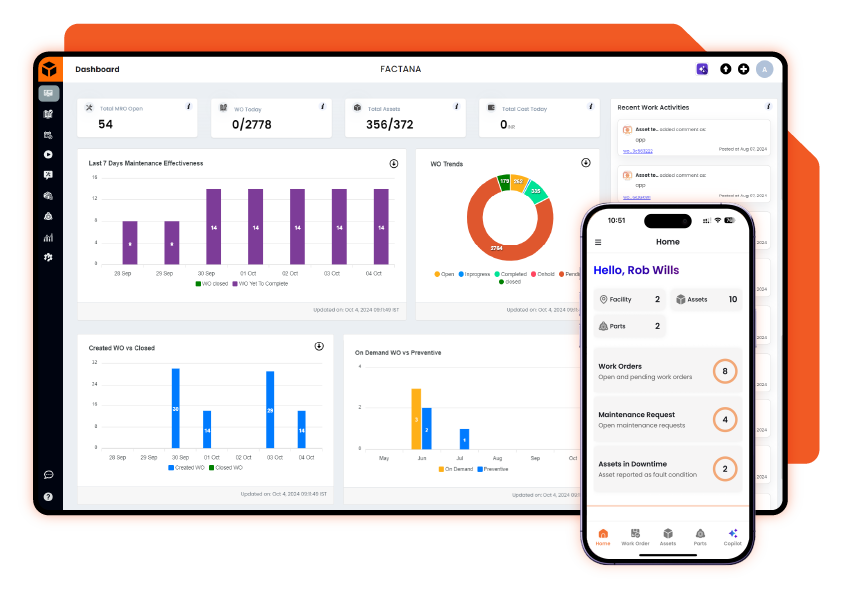
Fogwing CMMS is one of the fastest-growing AI-powered CMMS platforms adopted in the Philippines manufacturing and facility operations. It is designed for teams moving away from Excel and paper logs toward preventive, compliance-driven maintenance.
What it’s great for
Businesses in the Philippines that want to move away from manual logs and scattered spreadsheets, and are looking for a maintenance system that’s simple to use, works well on mobile, and doesn’t come with heavy costs or complicated setup.
Key Features
Work order automation with real-time updates to reduce manual tracking
Asset management with full equipment and service history for audit clarity
Mobile app built for field technicians, even with inconsistent connectivity
AI-based failure prediction to cut unplanned downtime
Preventive maintenance scheduling to avoid last-minute breakdowns
Simple, intuitive UI that technicians and managers can adopt quickly
Best for
SMEs to larger enterprises in manufacturing, logistics, food & beverage manufacturing , commercial buildings, and industrial plants.
2. Accruent
Accruent is a strong global CMMS player, widely used by large enterprises in the Philippines such as hospitals, utilities, and retail chains.
What it’s great for
Organizations that need a deep compliance-oriented solution with enterprise-level reporting.
Key Features
- Advanced asset lifecycle management
- Energy & facility management tools
- Powerful integrations with ERP systems
- Strong analytics & dashboards
Best for
Hospitals, universities, property management firms, and complex multi-site operations.
3. HorizonCore CMMS
HorizonCore offers a flexible CMMS platform with customizable modules, ideal for companies that need tailored operations.
What it’s great for
Philippine manufacturers & SMEs needing configurable workflows.
Key Features
- Custom modules
- Work order automation
- Inventory & spares management
Best for
Small to mid-sized industrial businesses needing flexibility.
4. Maximo PH (IBM Partner)
Maximo helps MSMEs transition from spreadsheets to digital maintenance without enterprise-level complexity.
What it’s great for
Critical infrastructure, public utilities, and large-scale organizations.
Key Features
- Robust asset hierarchy support
- Detailed maintenance workflows
- Enterprise integrations
- Local support team within PH
Best for
Utilities, LGUs, infrastructure operations.
5. Fiix CMMS
Fiix is a globally recognised CMMS ideal for factories adopting Industry 4.0 and IoT technologies. Its open API and integrations make it easy to connect with ERP or automation systems.
What it’s great For
Factories that want real-time visibility, connected machines, and smarter maintenance decisions.
Key Features:
Seamless ERP and production system integration
Customisable dashboards and analytics for KPIs like MTBF and MTTR
IoT connectivity for predictive maintenance
Multi-site management tools for plant performance comparison
Best For
Manufacturers embracing Industry 4.0, IoT integration, and data-driven maintenance operations.
6. FacilityBot
FacilityBot is primarily a facility maintenance CMMS, not a production-line CMMS, but it is used by light industrial plants for building and support equipment maintenance.
What it’s great for
Facilities teams and manufacturing plants that need a simple, fast-to-deploy CMMS for work requests and facility upkeep.
Key Features
Chat-based work order system (WhatsApp, Viber, FB Messenger)
Preventive maintenance scheduling
Asset & facility tracking
Tenant/employee issue reporting
Mobile-friendly technician workflows
Strong SEA presence
Best for
Buildings, campuses, malls, and manufacturing plants that want a lightweight CMMS for facilities and support equipment.
When evaluating modern plant operations, manufacturers increasingly look for platforms that balance preventive maintenance, compliance tracking, and mobile-first execution. Among the solutions reviewed, Fogwing CMMS emerges as a strong fit for Philippine manufacturers looking for a balance of preventive maintenance, compliance support, mobile accessibility, and operational affordabilit
A quick comparison of Top CMMS Software in Philippines :
Sometimes you just need to see it all laid out. Here’s a quick comparison to help you weigh them up.
| Feature | Fogwing CMMS | Accruent | HorizonCore | Maximo PH | Fiix CMMS | FacilityBot |
|---|---|---|---|---|---|---|
|
Best For |
SMEs → Enterprise (Manufacturing, F&B, Industrial) |
Large Enterprises |
SMEs needing customization |
Utilities / Gov |
SMBs, Facilities |
Facilities, campuses, light industrial |
|
Key Strength |
AI insights, strong PM, mobile-first |
Enterprise compliance & analytics |
Customisable workflows |
Robust enterprise asset control |
Advanced analytics and integrations |
Chat-based work orders |
|
Ease of Use |
⭐⭐⭐⭐⭐ |
⭐⭐ ⭐ |
⭐⭐ ⭐⭐ |
⭐⭐⭐ |
⭐⭐⭐⭐⭐ |
⭐⭐ ⭐⭐ |
|
Mobile App |
Excellent |
Moderate |
Good |
Moderate |
Excellent |
Excellent |
|
Support |
Global + Local |
Global |
Global |
Local |
Global |
SEA regional |
|
Pricing |
$15/month |
$110/month |
Not Available |
Customized |
$45/month |
$460/month |
How to Choose the Best CMMS Software in Philippines ?
Before finalizing, ask yourself:
1. Is it easy for your technicians?
If it’s too complicated, they won’t use it.
2. Does it support mobile?
Most Filipino maintenance teams spend 80% of their time on the floor or on-site.
3. Is there local support?
A PH-based support team is a huge advantage during emergencies.
4. Does it scale as you grow?
Look for cloud-based solutions like Fogwing.
5. Does it handle compliance?
Especially if you follow DOLE, ISO 45001, ISO 9001, GMP, or food safety audits.
6. What’s the total cost?
Consider training, onboarding, add-ons, and long-term pricing.
To know more check out this detailed guide: How to choose the best cmms ?
Business Impact of CMMS in Manufacturing
Manufacturers implementing CMMS software typically aim to improve maintenance efficiency, reduce unplanned downtime, and gain better visibility into asset performance.
While results vary based on plant size and maintenance maturity, common improvements include:
| Operational Area | Typical Improvement |
|---|---|
|
Unplanned downtime |
15–30% reduction |
|
Preventive maintenance compliance |
25–40% improvement |
|
Work order response time |
Faster technician coordination |
|
Asset visibility |
Improved maintenance history tracking |
|
Audit readiness |
Faster documentation retrieval |
|
Spare parts management |
Reduced stock-related delays |
The Future of CMMS in Philippines
1. AI Will Shift Maintenance From Reactive to Predictive
AI-powered CMMS will help Filipino factories spot failures before they happen by analysing vibration, temperature, runtime, and past breakdowns. This is especially valuable for food processors, where one faulty chiller or filler machine can ruin entire batches.
2. IoT Will Turn Plants Into Fully Connected Production Lines
More equipment across Philippine industrial zones will use sensors that send real-time data into a CMMS. For temperature-sensitive sectors like seafood, frozen foods, and beverages, this means issues are caught instantly instead of after damage is done.
3. Mobile-First Maintenance Will Become Standard
Technicians prefer mobile tools for quick updates on the floor. Future CMMS platforms will revolve around mobile apps for capturing photos, updating tasks, and tracking repairs in seconds eliminating documentation gaps between shifts.
4. Compliance Automation Will Be a Big Advantage
Stricter FDA, HACCP, GMP, and export regulations mean factories need airtight records. CMMS tools will automate sanitation logs, calibration data, and audit trails to help manufacturers pass inspections without stress.
5. Energy and Sustainability Will Shape Maintenance Decisions
With rising electricity costs, future CMMS platforms will track energy-heavy assets and highlight inefficiencies. This helps plants reduce power usage, improve asset health, and meet sustainability goals.
6. CMMS Will Integrate Into the Full Smart Factory Ecosystem
CMMS will no longer work alone , CMMS will integrate with ERP, MES, quality, and inventory systems. This unified ecosystem will help manufacturers plan better, minimize downtime, and run more predictable operations.
Final Thoughts
Selecting the best CMMS software in the Philippines is more than a tech decision; it’s a strategy for cutting downtime, boosting productivity, and empowering your maintenance team.
Among the available options, Fogwing CMMS stands out as the Best Overall CMMS for Philippine Manufacturing, offering the right balance of cost, compliance, and ease of use.
FAQs
1. What happens if a factory still uses Excel for maintenance tracking?
Manual spreadsheets often lead to missed preventive maintenance schedules, inconsistent reporting, and limited visibility into asset history. CMMS platforms centralise maintenance records and improve coordination between technicians and supervisors.
2. Can small manufacturing companies in the Philippines afford CMMS software?
Many modern CMMS platforms like Fogwing CMMS now offer cloud-based pricing models suitable for SMEs, allowing smaller manufacturers to adopt preventive maintenance systems without large upfront infrastructure costs.
3. What is the best CMMS software in the Philippines?
Some of the best CMMS software in the Philippines include:
Accruent
HorizonCore
IBM Maximo (PH Partner)
Fiix CMMS
FacilityBot
4. Which industries benefit most from CMMS software in the Philippines?
Industries such as food processing, beverage manufacturing, seafood exports, packaging, utilities, logistics, and industrial facilities commonly use CMMS software to reduce downtime and improve maintenance visibility.
5. How long does CMMS implementation usually take?
Implementation timelines vary depending on asset volume, workflow complexity, and integrations. Smaller facilities may deploy basic CMMS workflows within weeks, while enterprise-scale deployments may take longer.