For automotive manufacturers and OEM suppliers, maintaining reliable production equipment is essential for delivering consistent product quality, meeting production targets, and satisfying customer requirements. A machine breakdown is not simply a maintenance issue. Equipment failure can result in production downtime, process variation, product defects, scrap and rework, missed delivery commitments, customer complaints, increased maintenance costs, and failure to meet customer-specific requirements.
This is why IATF 16949 preventive maintenance is an important part of an effective quality management system. IATF 16949 specifically addresses maintenance through Clause 8.5.1.5 – Total Productive Maintenance (TPM). The requirement focuses on proactive and preventive techniques for improving the reliability of tooling and manufacturing equipment.
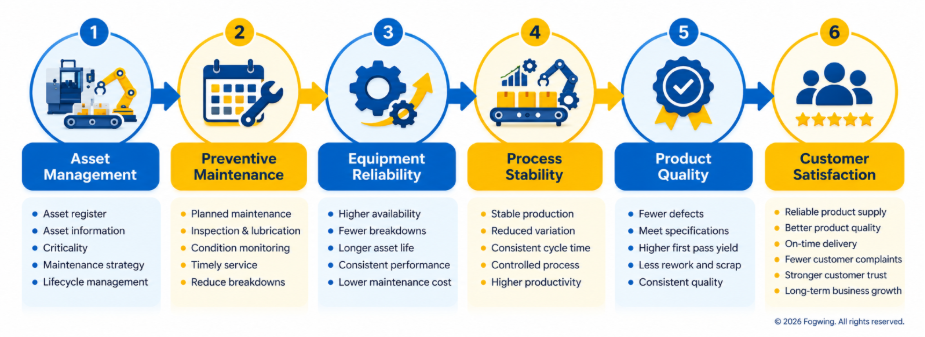
Achieving IATF 16949 is not simply a matter of creating a preventive maintenance schedule. Automotive manufacturers need a structured system that connects:
What Is IATF 16949?
IATF 16949 is the automotive industry’s quality management system standard. It builds upon ISO 9001 and introduces additional requirements specifically addressing the automotive supply chain.
- Customer satisfaction
- Defect prevention
- Risk-based thinking
- Process capability
- Manufacturing process control
- Continual improvement
- Problem solving
- Customer-specific requirements
- Product and process quality
Compliance Connection:
Relevant IATF 16949 areas: Clause 4.4 – Quality management system and its processes; Clause 5.1.1 – Leadership and commitment; Clause 6.1 – Actions to address risks and opportunities; Clause 8.5 – Production and service provision; Clause 8.5.1.5 – Total Productive Maintenance; Clause 10.3 – Continual improvement.
How it helps: A structured maintenance system provides evidence that manufacturing equipment is controlled, monitored, maintained, and continuously improved as part of the organization’s manufacturing and quality processes.
IATF 16949 Preventive Maintenance Practices for Automotive Manufacturers
1. Establish a Complete Asset Register
A preventive maintenance program starts with a clear understanding of the equipment used in the manufacturing process. An automotive plant may have thousands of assets, including CNC machines, press machines, welding robots, injection molding machines, conveyors, compressors, hydraulic systems, assembly equipment, inspection equipment, and testing equipment.
- Asset ID and equipment name
- Manufacturer, model, and serial number
- Location and production line
- Installation date and asset category
- Asset criticality
- Manufacturer maintenance recommendations
- Associated spare parts
- Maintenance history
Compliance Connection:
Relevant IATF 16949 areas: Clause 7.1.3 – Infrastructure; Clause 8.5.1 – Control of production and service provision; Clause 8.5.1.5 – Total Productive Maintenance.
How it helps: A complete asset register provides the foundation for controlling production equipment, defining maintenance responsibilities, establishing maintenance plans, and demonstrating that critical equipment is systematically managed.
2. Identify Critical Production Assets
Not every asset presents the same level of operational or quality risk. A failure of a critical CNC machine may stop an entire production line, while failure of a non-critical auxiliary asset may have limited impact. Manufacturers should therefore perform asset criticality assessment.
- Production impact
- Product quality impact
- Safety and environmental impact
- Failure frequency
- Availability of backup equipment
- Spare-parts availability
- Customer impact
- Impact on special characteristics
Compliance Connection:
Relevant IATF 16949 areas: Clause 6.1 – Risk and opportunity; Clause 8.5.1.5 – Total Productive Maintenance; Clause 8.5.1.7 – Production scheduling; Clause 8.5.6 – Control of changes.
How it helps: Criticality analysis provides a risk-based method for determining which equipment requires greater maintenance attention and helps prioritize resources around equipment that can significantly affect manufacturing performance and product conformity.
3. Develop Equipment-Specific Preventive Maintenance Plans
An IATF 16949 preventive maintenance program should not rely on a generic “service every 30 days” approach. Each critical asset should have a defined maintenance strategy based on operating conditions, failure history, manufacturer recommendations, and production requirements.
- Lubrication and cleaning
- Inspection and component replacement
- Torque, alignment, electrical, hydraulic, and pneumatic checks
- Safety-device verification
- Calibration
- Wear-part replacement
- Periodic overhaul
Compliance Connection:
Relevant IATF 16949 areas: Clause 8.5.1.5 – Total Productive Maintenance. IATF 16949 Clause 8.5.1.5 requires an organization to establish, implement, and maintain a documented Total Productive Maintenance (TPM) system to ensure manufacturing equipment and tooling remain capable of consistently producing conforming products.
How it helps: Equipment-specific preventive maintenance plans demonstrate that the organization has proactively planned activities to maintain equipment and tooling reliability rather than relying exclusively on reactive repairs.
4. Implement Total Productive Maintenance
IATF 16949 uses the term Total Productive Maintenance within Clause 8.5.1.5. A mature TPM program involves maintenance personnel and production operators in keeping equipment reliable and detecting abnormalities early.
- Autonomous maintenance
- Cleaning and lubrication
- Inspection and early abnormality detection
- Planned maintenance
- Equipment improvement
- Maintenance performance measurement
- Operator involvement
- Reliability improvement
Compliance Connection:
Relevant IATF 16949 areas: Clause 8.5.1.5 – Total Productive Maintenance. The IATF clarifies that TPM under this clause focuses on proactive and preventive techniques that improve equipment and tooling reliability, involving equipment, processes, and people
How it helps: TPM provides direct evidence that the organization is using proactive and preventive practices to improve manufacturing equipment and tooling reliability.
5. Standardize Preventive Maintenance Procedures
A maintenance task should not depend entirely on the experience of one technician. Standardized procedures create consistency and reduce the possibility of missed maintenance activities.
- Task description
- Inspection points
- Measurement requirements
- Acceptance criteria
- Tools and safety precautions
- Replacement components and lubricants
- Expected condition
- Escalation requirements
Compliance Connection:
Relevant IATF 16949 areas: Clause 7.5 – Documented information; Clause 8.5.1 – Control of production and service provision; Clause 8.5.1.5 – Total Productive Maintenance.
How it helps: Standardized maintenance instructions establish consistent execution and provide controlled evidence that maintenance activities are performed according to defined requirements.
6. Record Every Maintenance Activity
One of the biggest weaknesses in managing IATF 16949 preventive maintenance manually is incomplete documentation. A maintenance activity should generate a traceable record showing what was done, when it was done, which asset was serviced, who performed the work, what was inspected, what was found, what measurements were recorded, what parts were replaced, and what corrective action was required.
- Asset and work order
- Maintenance type and technician
- Checklist and findings
- Measurements and parts
- Labor and downtime
- Result and approval
Compliance Connection:
Relevant IATF 16949 areas: Clause 7.5 – Documented information; Clause 8.5.1.5 – Total Productive Maintenance; Clause 9.1 – Monitoring, measurement, analysis and evaluation.
How it helps: Electronic maintenance records provide objective evidence that planned maintenance was performed and create historical data for audits, management reviews, and improvement activities.
7. Measure Preventive Maintenance Performance
An IATF 16949 preventive maintenance program should be measured continuously. Creating preventive maintenance schedules does not prove that the maintenance system is effective. Organizations should monitor maintenance KPIs.
- PM Compliance
- MTBF – Mean Time Between Failures
- MTTR – Mean Time To Repair
- Equipment Availability
- Breakdown Frequency
- Planned Maintenance Percentage
- Maintenance Cost
Compliance Connection:
Relevant IATF 16949 areas: Clause 9.1.1 – Monitoring, measurement, analysis and evaluation; Clause 9.1.1.1 – Monitoring and measurement of manufacturing processes; Clause 9.3 – Management review; Clause 10.3 – Continual improvement.
How it helps: Maintenance KPIs demonstrate whether the maintenance process is effective and provide measurable evidence for performance evaluation and continual improvement.
8. Link Equipment Maintenance to Product Quality
Maintenance and quality should not operate as isolated functions. Equipment condition can directly affect product characteristics. For example, spindle vibration can lead to machine instability, dimensional variation, and defective components.
- Defects
- Scrap and rework
- Process deviations
- Customer complaints
- Product variation
- Special characteristics
- Corrective actions
Compliance Connection:
Relevant IATF 16949 areas: Clause 8.5.1 – Control of production; Clause 8.7 – Control of nonconforming outputs; Clause 10.2 – Nonconformity and corrective action.
How it helps: Linking maintenance events with quality events helps organizations investigate equipment-related causes of defects and establish effective corrective actions.
9. Perform Failure Analysis and Root Cause Analysis
A mature maintenance organization does not stop at ‘Motor failed.’ It asks why the motor failed. Possible causes may include bearing degradation, poor lubrication, misalignment, excessive load, cooling failure, electrical problems, incorrect installation, or operating conditions.
- Failure
- Failure mode
- Potential cause
- Root cause
- Corrective action
- Preventive action
- Maintenance strategy improvement
Compliance Connection:
Relevant IATF 16949 areas: Clause 10.2.3 – Problem solving; Clause 10.2.4 – Error-proofing; Clause 10.3 – Continual improvement.
How it helps: Structured failure and root-cause analysis demonstrates that the organization is addressing recurring equipment problems systematically rather than repeatedly repairing symptoms.
10. Implement Condition-Based Maintenance
Traditional preventive maintenance is often time-based. Modern automotive plants can supplement it with condition-based maintenance using sensors and industrial IoT.
- Vibration
- Temperature
- Pressure
- Current
- Speed
- Flow
- Energy consumption
- Oil condition
Compliance Connection:
Relevant IATF 16949 areas: Clause 8.5.1.5 – Total Productive Maintenance; Clause 9.1.1 – Monitoring, measurement, analysis and evaluation; Clause 10.3 – Continual improvement.
How it helps: Condition monitoring strengthens proactive maintenance and provides objective equipment-condition data that can be used to prevent failures.
11. Manage Calibration and Measurement Equipment
Automotive manufacturing depends heavily on measurement and inspection equipment. These instruments must be appropriately controlled and maintained to ensure reliable measurement results.
- Equipment identification
- Calibration frequency
- Calibration status
- Due dates
- Calibration records and certificates
- Out-of-calibration events
- Impact assessment
Compliance Connection:
Relevant IATF 16949 areas: Clause 7.1.5 – Monitoring and measuring resources; Clause 7.1.5.1.1 – Measurement systems analysis; Clause 7.1.5.2.1 – Calibration/verification records.
How it helps: A controlled calibration program helps ensure that measurement results used for product and process decisions are reliable and traceable.
12. Plan for Equipment Failure and Production Continuity
Even an excellent preventive maintenance program cannot eliminate every equipment failure. Automotive manufacturers therefore need contingency planning for significant disruptions.
- Critical machine failure
- Utility failure
- Major equipment breakdown
- Spare-part shortage
- Supplier disruption
- Natural disaster
- IT system failure
Compliance Connection:
Relevant IATF 16949 areas: Clause 6.1.2.1 – Risk analysis; Clause 6.1.2.2 – Preventive action; Clause 6.1.2.3 – Contingency plans.
How it helps: Maintenance risk assessment and contingency planning help reduce the impact of major equipment failures and support continuity of customer supply.
13. Maintain Audit-Ready Maintenance Records
During an IATF audit or customer audit, the organization needs to demonstrate that its maintenance processes are not merely documented but actually implemented.
- Asset register
- Preventive maintenance plans
- Completed work orders
- Equipment breakdown history
- PM compliance
- Calibration records
- Spare-parts records
- Failure and root cause analysis
- Corrective actions
- Maintenance performance trends
Compliance Connection:
Relevant IATF 16949 areas: Clause 7.5 – Documented information; Clause 9.1 – Performance evaluation; Clause 9.2 – Internal audit; Clause 9.3 – Management review; Clause 10.3 – Continual improvement.
How it helps: A centralized maintenance history creates objective evidence that the organization’s maintenance system is operating as planned and is being evaluated for effectiveness.
14. Build a Risk-Based Maintenance Strategy
Not every asset should receive the same maintenance frequency. A risk-based approach directs maintenance resources toward assets that present the greatest operational and quality risk.
- Critical CNC – High risk – PM + condition monitoring
- Welding robot – High risk – PM + inspection
- Compressor – High risk – PM + condition monitoring
- Conveyor – Medium risk – preventive maintenance
- Office HVAC – Low risk – basic PM
- Lighting – Low risk – corrective maintenance
Compliance Connection:
Relevant IATF 16949 areas: Clause 6.1 – Actions to address risks and opportunities; Clause 8.5.1.5 – Total Productive Maintenance; Clause 10.3 – Continual improvement.
How it helps: Risk-based maintenance aligns maintenance resources with equipment criticality and the potential impact of equipment failure on product quality and customer requirements.
IATF 16949 Maintenance Compliance – Comprehensive
The following practical mapping shows how common maintenance practices contribute to an IATF 16949 quality management system. The mapping is intended as an operational guide and should not be interpreted as a guarantee of certification.
| Maintenance Practice | Relevant IATF 16949 Area | Compliance Contribution |
| Asset Register | 7.1.3, 8.5.1.5 | Equipment identification and control |
| Asset Criticality | 6.1 | Risk-based prioritization |
| PM Planning | 8.5.1.5 | Preventive equipment maintenance |
| TPM | 8.5.1.5 | Equipment reliability |
| Maintenance Procedures | 7.5, 8.5.1 | Standardized execution |
| Maintenance Records | 7.5 | Objective evidence |
| PM KPIs | 9.1 | Performance monitoring |
| Equipment-Quality Link | 8.5, 8.7, 10.2 | Defect prevention and corrective action |
| Root Cause Analysis | 10.2.3 | Problem solving |
| Condition Monitoring | 8.5.1.5, 9.1 | Proactive maintenance |
| Calibration | 7.1.5 | Reliable measurement |
| Contingency Planning | 6.1.2.3 | Production continuity |
| Maintenance Audits | 9.2 | System effectiveness |
| Continual Improvement | 10.3 | Maintenance system improvement |
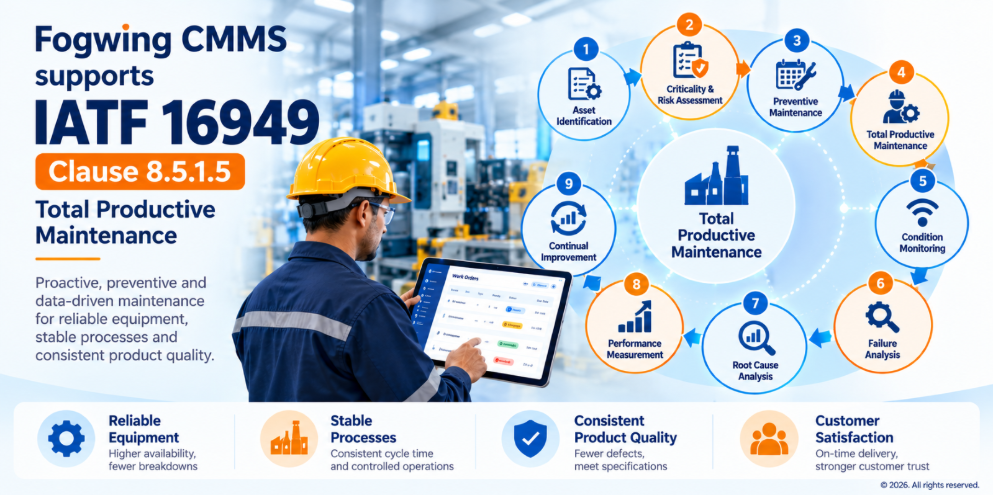
How Fogwing CMMS Support IATF 16949?
A modern CMMS can turn preventive maintenance from a collection of spreadsheets and manual reminders into a controlled, measurable, and auditable process. Fogwing CMMS provides a centralized platform for managing IATF 16949 preventive maintenance and the maintenance lifecycle of production assets.
Centralized Asset Management:
Fogwing CMMS provides a centralized view of production assets, allowing manufacturers to organize assets through a structured hierarchy and maintain essential information such as asset location, lifecycle, criticality, meter readings, and maintenance history. This gives maintenance teams a complete view of each asset and helps them make informed decisions about maintenance priorities, equipment reliability, and lifecycle management.
Preventive Maintenance Management:
Fogwing CMMS enables manufacturers to establish preventive maintenance programs based on time, meter readings, equipment usage, production cycles, or asset condition. Maintenance schedules can automatically generate work orders when predefined conditions or intervals are reached, helping maintenance teams perform planned activities on time and reduce unexpected equipment breakdowns.
Digital Maintenance Checklists:
With digital maintenance checklists, technicians can systematically perform inspections and record inspection results, measurements, observations, and pass/fail status directly against the asset or work order. Corrective actions can also be documented along with technician details, creating a consistent and traceable maintenance execution process.
Breakdown and Corrective Maintenance:
Fogwing CMMS helps maintenance teams capture and manage equipment breakdowns by documenting failure symptoms, failure modes, probable causes, corrective actions, downtime, parts consumed, labor, and final resolution. This creates a detailed breakdown history that can be used to identify recurring failures, improve maintenance strategies, and increase equipment reliability.
IoT-Based Condition Monitoring:
By connecting equipment and sensor data with maintenance processes, Fogwing CMMS can support condition-based maintenance. Machine data can be analyzed against predefined thresholds to identify abnormal conditions and generate maintenance notifications or work orders. This enables manufacturers to move from reactive maintenance toward proactive and predictive maintenance based on actual equipment conditions.
AI-Assisted Maintenance:
AI capabilities can assist maintenance teams in analyzing equipment and maintenance information more effectively. Fogwing CMMS can support use cases such as root cause analysis, work-order summaries, maintenance checklist generation, maintenance note assistance, asset intelligence, and failure pattern analysis. These capabilities help technicians and maintenance managers convert maintenance data into actionable insights and improve decision-making.
Maintenance KPI Dashboard:
Fogwing CMMS provides visibility into important maintenance performance indicators such as preventive maintenance compliance, equipment availability, MTBF, MTTR, breakdown frequency, maintenance workload, maintenance cost, overdue maintenance, and overall asset performance. These metrics help maintenance leaders identify performance gaps, monitor trends, evaluate maintenance effectiveness, and continuously improve equipment reliability.
Audit-Ready Maintenance History:
Fogwing CMMS maintains a digital history of maintenance activities for each asset, including assets, work orders, checklists, findings, parts used, technicians, completion details, and historical maintenance records. This centralized and traceable information helps organizations demonstrate that maintenance activities are planned, executed, documented, and monitored, supporting audit readiness and evidence-based maintenance management.
By bringing these capabilities together, Fogwing CMMS can help manufacturers connect assets, preventive maintenance, IoT data, work orders, reliability analytics, and maintenance evidence in one digital system.
IATF 16949 Starts with Reliable Equipment
IATF 16949 is ultimately about creating a manufacturing system capable of consistently delivering products that meet customer requirements. Reliable equipment is an important part of that system.
A strong maintenance strategy follows this progression:
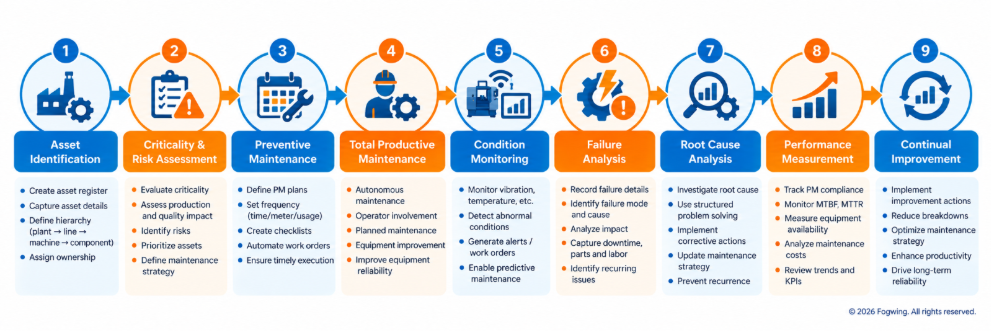
When these practices are supported by a digital CMMS, maintenance becomes more than a reactive repair function. It becomes a data-driven manufacturing reliability process that supports quality, production continuity, audit readiness, and customer satisfaction.
Conclusion
IATF 16949 preventive maintenance is not just about servicing machines on time. It is about systematically managing equipment reliability so that manufacturing processes remain capable, stable, and controlled.
By combining preventive maintenance, TPM, condition monitoring, equipment criticality, failure analysis, calibration, maintenance KPIs, and digital maintenance records, automotive manufacturers can create a stronger foundation for their IATF 16949 quality management system.
Fogwing CMMS brings these practices together in a digital maintenance platform, helping automotive manufacturers connect assets, maintenance, IoT data, work orders, reliability, analytics, and audit evidence in one system.
Important Compliance Note
IATF 16949 certification applies to an organization’s complete quality management system. A CMMS, preventive maintenance program, or individual maintenance activity does not by itself make an organization IATF 16949 certified. Organizations should evaluate the current IATF 16949 standard, applicable customer-specific requirements, and guidance from their certification body when establishing their compliance program.
FAQs on IATF 16949 Preventive Maintenance Practices
1. What is IATF 16949 preventive maintenance?
IATF 16949 preventive maintenance is a structured approach to maintaining manufacturing equipment and tooling to improve reliability, prevent failures, and support consistent product quality.
2. What does IATF 16949 require for preventive maintenance?
IATF 16949 Clause 8.5.1.5 requires organizations to establish, implement, and maintain a documented Total Productive Maintenance (TPM) system for manufacturing equipment and tooling.
3. What are the key preventive maintenance practices for IATF 16949?
Key practices include asset management, equipment criticality assessment, preventive maintenance planning, TPM, standardized procedures, maintenance records, KPI monitoring, condition monitoring, calibration, failure analysis, and risk-based maintenance.
4. How does preventive maintenance support IATF 16949 compliance?
Preventive maintenance helps maintain equipment reliability, reduce unplanned downtime, prevent process variation, support product quality, and provide documented evidence of maintenance activities during audits.
5. How can Fogwing CMMS support IATF 16949 preventive maintenance?
Fogwing CMMS helps automotive manufacturers manage assets, schedule preventive maintenance, create work orders, record inspections and maintenance activities, monitor equipment performance, and maintain centralized maintenance history for audit readiness.