
Best Asset Management Software for Mining
Choosing the Right Platform for Modern Mining Operations
What maintenance leaders should prioritise before investing in 2026
Table of Contents
Mining in 2026 is no longer just about extraction; it’s about running highly complex, asset-intensive operations across remote locations while maintaining safety, uptime, and profitability.
Whether you’re operating an open-pit iron ore mine in Western Australia, managing underground copper assets in Chile, or running coal operations in South Africa, one reality stays constant:
Your operation depends on equipment reliability.
Haul trucks, drills, crushers, conveyors, substations, processing plants. Every asset represents a major investment. When something fails unexpectedly, the cost isn’t limited to repairs. Production slows. Safety risks increase. Teams scramble.
Yet many mining environments still rely on fragmented tracking systems, spreadsheets, or reactive maintenance habits.
That’s exactly why asset management software for mining has shifted from a support tool to a core operational system. Platforms such as Fogwing EAM, IBM Maximo, and other modern enterprise asset management solutions are increasingly being evaluated by mining operators looking to improve maintenance visibility, equipment reliability, and operational coordination across distributed sites.
This 2026 buyer’s guide explains what mining asset management software really does, where it delivers immediate value, and how to choose a platform that fits your operational reality.
Why Mining Teams Are Rethinking Asset Management in 2026
Mining assets live hard lives. They operate in dust, vibration, heat, moisture, and remote terrain, often around the clock. Even well-maintained equipment experiences wear patterns that are difficult to track without structured systems.
At the same time, mining organisations face growing pressure:
- Production targets are tighter
- Downtime costs are higher
- Compliance expectations are stricter
- Equipment lifecycles are longer and more complex
In this environment, reactive maintenance becomes expensive and unpredictable.
Modern mining asset management software allows teams to shift from “fix it when it breaks” toward planned maintenance strategies backed by data. Instead of guessing asset condition, teams gain visibility into performance trends, maintenance history, and failure patterns.
That shift doesn’t just reduce breakdowns, it improves planning, crew coordination, and long-term capital decisions.
What Asset Management Software for Mining Really Means
At its core, asset management software gives mining teams a structured way to understand and manage the entire lifecycle of their equipment.
Think of it as a living system that connects:
- Asset inventory and hierarchy
- Maintenance schedules
- Inspection records
- Downtime tracking
- Performance analytics
Rather than scattered documents and disconnected logs, every asset tells a story of what work was done, when it was serviced, how it’s performing, and what attention it may need next.
For mining operations managing fleets across multiple pits or regions, this central visibility becomes essential. Modern EAM platforms like Fogwing EAM and similar mining-focused systems help maintenance teams centralise asset history, inspections, downtime trends, and preventive maintenance activities within a single operational framework.
How Mining Teams Use Asset Management Software Day to Day
In real mining environments, asset management software isn’t just an administrative tool; it becomes part of the daily operational rhythm.
A planner might begin the day reviewing upcoming preventive work across haul trucks and fixed plant equipment. Instead of reacting to overnight failures, the team sees what maintenance is due and allocates technicians accordingly.
On the ground, technicians using enterprise asset management platforms such as Fogwing EAM can receive digital work orders, complete inspections onsite, and immediately record findings from mobile devices. That information feeds directly into maintenance history and operational reporting workflows.
Over time, patterns begin to emerge. A conveyor showing repeated stress indicators. A drill fleet trending toward higher service intervals. These insights allow teams to intervene early rather than respond to breakdowns.
Common day-to-day outcomes include:
- Better coordination between maintenance crews
- Reduced surprise failures
- Faster troubleshooting
- More accurate maintenance history
- Improved planning across shifts
The result isn’t just smoother workflows, it’s greater operational confidence.
Where Asset Management Software Delivers Immediate Value in Mining
Mining environments vary widely, but the value of structured asset management shows up in very practical scenarios.
Large open-pit operations benefit from coordinated fleet maintenance, where uptime directly affects production throughput. Underground mines rely on consistent inspection tracking to maintain safety and equipment reliability.
Processing plants use asset performance history to reduce bottlenecks, while remote sites depend on centralized visibility to support distributed teams.
You’ll see immediate impact in environments such as:
- Multi-site mining networks spread across regions
- Heavy mobile equipment fleets
- Mineral processing facilities
- Renewable-powered mining sites
- Contract maintenance operations
Whether in Australia’s Pilbara, Canada’s mining corridors, Chile’s Atacama region, Africa’s mineral belts, or India’s industrial mining zones, structured asset management reduces uncertainty and uncertainty is one of the highest hidden costs in mining.
Before Comparing Vendors: What Actually Matters
Mining teams often jump straight into product comparisons. But the smarter step is defining what operational problems you’re trying to solve.
The best asset management software for mining should help you:
- Move toward preventive and predictive maintenance
- Support distributed, multi-site operations
- Track high-value assets over long lifecycles
- Provide meaningful performance insight
- Scale as operations grow
If a platform only logs equipment details without improving decision-making, it won’t keep pace with modern mining demands.
Bes Asset Management Software for Mining in 2026
Here’s a snapshot of the most trusted asset management software platforms mining operations evaluate in 2026 focused on reliability, maintenance coordination, and lifecycle visibility across heavy equipment environments:
Fogwing EAM – Maintenance-driven EAM with predictive capabilities, multi-site asset visibility, and strong support for mining equipment lifecycle management
RPMGlobal AMT – Mining-focused asset tracking platform designed for fleet-heavy operations and maintenance coordination
IBM Maximo – Enterprise-grade asset lifecycle and compliance platform widely used in large, safety-critical mining environments
IFS Cloud – Integrated EAM + ERP system supporting large-scale mining operations with asset, finance, and supply chain workflows
Leading Asset Management Software for Mining (2026)
1. Fogwing EAM
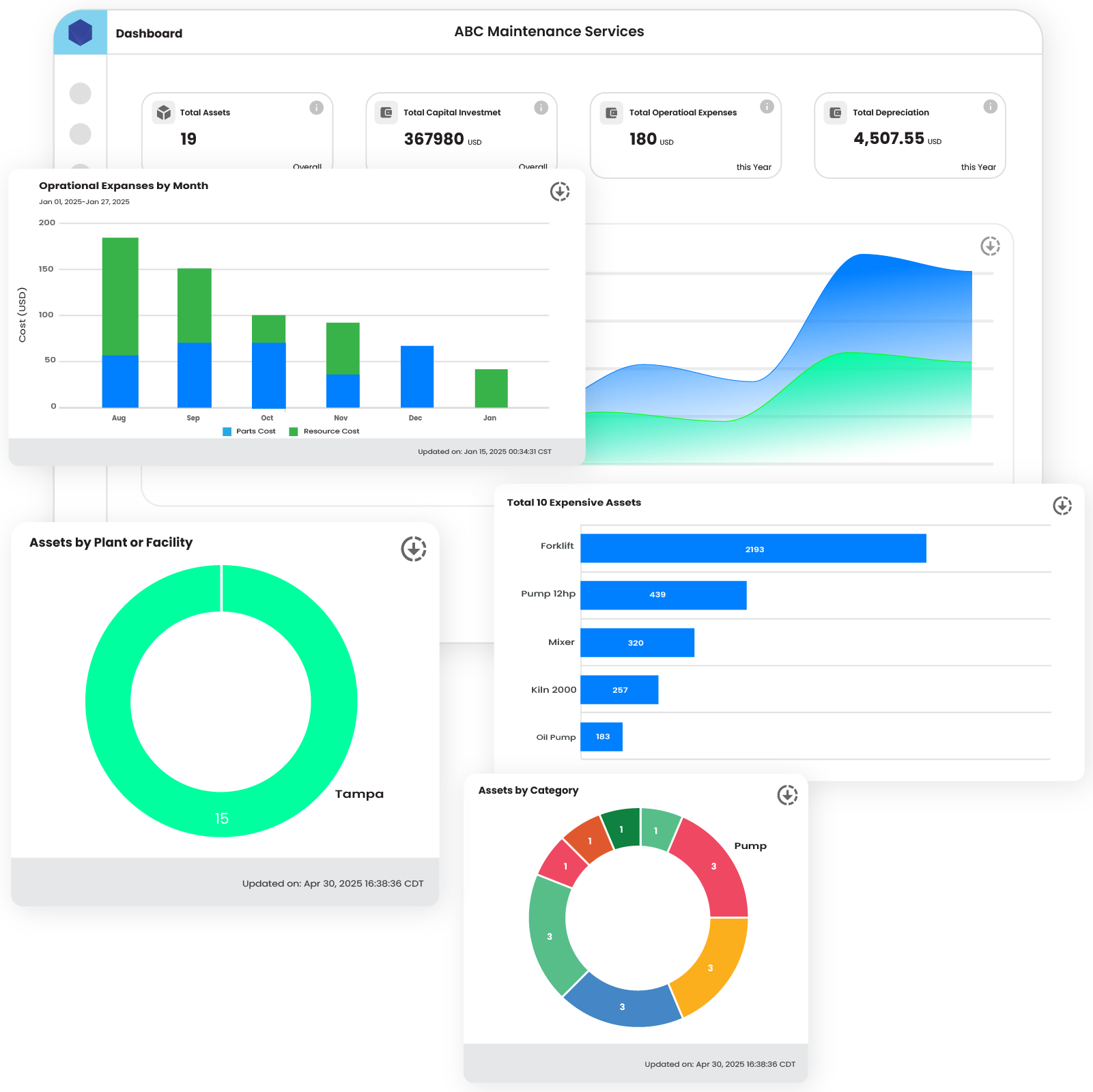
Fogwing EAM provides an enterprise asset management platform designed for asset-intensive industries where uptime, maintenance coordination, and lifecycle visibility are critical. In mining environments, the platform supports preventive maintenance scheduling, equipment inspections, downtime analytics, asset hierarchy management, and multi-site operational visibility across heavy mobile and fixed mining assets.
Best for: Mid-large mining operations seeking maintenance-driven, scalable EAM.
Fogwing EAM is a full enterprise asset management platform built for asset-intensive industries, including mining. It supports lifecycle management, preventive maintenance, performance analytics, and multi-site visibility.
Strengths:
- Predictive and preventive maintenance
- Work orders and inspections
- Real-time downtime analytics
- Scales across distributed mining sites
Considerations:
- Requires structured data setup initially
2. RPMGlobal AMT
RPMGlobal develops mining-focused operational software, with its asset management tools built around real-world fleet maintenance and equipment reliability challenges. The system is tailored to environments where heavy machinery uptime, crew coordination, and parts planning play a central role in production continuity.
Best for: Mining operations with heavy mobile fleets and maintenance complexity.
RPMGlobal AMT (Asset Management and Tracking) is designed with mining realities in mind blending asset health, crew planning, and parts inventory into one system.
Strengths:
- Deep mining-centric workflows
- Strong fleet and maintenance coordination
- Built for rugged, distributed mining environments
Considerations:
- May require integration with broader enterprise systems
3. IBM Maximo
IBM’s Maximo platform is a long-established enterprise asset management system used in industries that demand strict lifecycle control and compliance tracking. Within mining, it supports large-scale asset portfolios, safety-driven workflows, and integrated maintenance planning across complex operational ecosystems.
Best for: Large enterprise mining companies with complex compliance needs.
IBM Maximo is one of the most established enterprise asset management systems globally. It’s widely used by mines with strict safety requirements and huge equipment portfolios.
Strengths:
- Robust lifecycle and compliance features
- Mature ecosystem and integrations
- Scales to global mining portfolios
Considerations:
- Higher implementation and ownership costs
- Needs dedicated expertise
4. IFS Cloud
IFS delivers an integrated enterprise platform combining asset management with broader operational systems such as finance and supply chain. For mining organisations, it provides a unified framework to manage equipment lifecycle, maintenance coordination, and enterprise workflows within a single environment.
Best for: Mines seeking an integrated EAM + ERP platform with global scale.
IFS Cloud offers a broad enterprise platform that includes asset management, maintenance, supply chain, and finance, which can be powerful for complex mining organisations.
Strengths:
- Integrated EAM + ERP workflows
- Strong multi-site and regulatory support
- Good for global mining enterprises
Considerations:
- Can be complex depending on the deployment scope
When mining teams evaluate asset management platforms, the focus is increasingly on preventive maintenance, lifecycle visibility, and multi-site coordination. Among the solutions reviewed, Fogwing EAM is increasingly evaluated alongside established mining asset management platforms by operations seeking preventive maintenance control, downtime intelligence, multi-site asset visibility, and scalable lifecycle management across mining equipment environments.
Comparison Table: Best Asset Management Software for Mining
Sometimes you just need to see it all laid out. Here’s a quick comparison to help you weigh them up.
| Feature / Aspect | Fogwing EAM | RPMGlobal AMT | IBM Maximo | IFS Cloud |
|---|---|---|---|---|
|
Preventive Maintenance |
✅ Strong |
✅ Strong |
✅ Strong |
✅Good |
|
Predictive Analytics |
✅ Yes |
✅ Yes |
✅ Yes |
⚠️ Partial |
|
Multi-Site Support |
Excellent |
Good |
Excellent |
Excellent |
|
Mining Equipment Support |
Yes |
Specialised |
Yes |
Yes |
|
Work Order Management |
Yes |
Yes |
Yes |
Yes |
|
Best Suited For |
Mid–Large Mines |
Mobile Fleet-Heavy Mines |
Enterprise Mines |
Integrated Enterprise Operations |
How to Choose the Right Platform for Your Mining Operation
No mining operation is identical. A gold producer with remote pits has very different needs compared to a coal operation managing centralized processing facilities.
Before shortlisting vendors, ask:
- How distributed are our assets?
- Is downtime our biggest cost risk?
- How critical are audits and compliance tracking?
- Do we need predictive insights or basic coordination?
The best system isn’t necessarily the most feature-rich , it’s the one your teams adopt naturally and use consistently.
From Asset Tracking to Operational Optimisation
Modern mining leaders are moving beyond simple asset tracking. They want insight the ability to anticipate failures, plan maintenance strategically, and manage lifecycle costs.
With the right asset management platform, teams gain:
- Early warning of reliability risks
- Reduced unplanned outages
- Better maintenance planning
- Clear repair vs replacement decisions
This transition from reactive repair to proactive optimisation is where mining organisations unlock measurable operational gains.
Final Thoughts
Mining success depends on reliable assets, disciplined maintenance, and visibility across complex environments.
The best asset management software for mining helps teams shift from firefighting to data-driven planning, whether operating in Australia, Chile, Canada, Africa, India, or anywhere mining assets drive production.
Ultimately, the goal isn’t software adoption. It’s operational clarity, reliability, and confidence.
FAQs
1.What is the best asset management software for mining?
It depends on operational scale and asset complexity. Fogwing EAM, RPMGlobal AMT, IBM Maximo, and IFS Cloud each serve different mining needs.
2. Can asset management software reduce downtime?
Yes. Preventive and predictive maintenance strategies significantly lower unexpected failures.
3. Is multi-site visibility important for mining?
Absolutely. Distributed mining operations rely on centralized asset insight for consistency and reliability.