
Asset Management Software for Construction: 2026 Buyer’s Guide
Best Asset Management Software for Construction
Choosing the Right Asset Management Software for Modern Construction Projects
Table of Contents
Construction in 2026 looks very different from even five years ago. Mega infrastructure projects in the Middle East, rapid urban development across India, and large-scale commercial construction in APAC regions are pushing construction companies to operate faster, leaner, and more digitally than ever before.
Yet, one challenge remains painfully common across construction sites from Dubai and Saudi Arabia to Singapore and India: Poor visibility into construction assets.
Heavy equipment, tools, vehicles, and rented assets are constantly moving across sites. Without the right asset management software, construction firms struggle with equipment downtime, misplaced tools, unplanned maintenance, and rising operational costs.
This is where asset management software for construction becomes critical, not as an IT add-on, but as a core operational system.
This 2026 buyer’s guide helps construction companies understand what modern asset management software should deliver and how to choose the right platform based on real, on-site needs not marketing claims.
Across modern construction projects, enterprise asset management platforms are increasingly replacing spreadsheet-based maintenance and disconnected tracking tools. Solutions like Fogwing EAM are being adopted by construction and infrastructure teams to improve equipment visibility, preventive maintenance execution, and multi-site asset control across regions like the Middle East, India, and APAC.
Why Asset Management Software Is Essential for Construction in 2026
Construction assets are expensive, mobile, and often underutilised. In high-growth regions like the Middle East and India, projects run on aggressive timelines, and equipment downtime can delay entire phases of construction.
Traditional methods manual logs, spreadsheets, or disconnected maintenance tools, can’t keep up with:
- Multiple job sites and subcontractors
- Shared and rented equipment
- Preventive maintenance requirements
- Safety and compliance expectations
- Rising fuel, labour, and equipment costs
Modern construction asset management software helps companies:
- Track equipment and tools across sites in real time
- Reduce asset downtime through preventive maintenance
- Improve utilisation of owned and rented assets
- Control maintenance costs and spare inventory
- Maintain audit-ready maintenance and safety records
For large construction firms operating across APAC, the Middle East, and India, asset management software is no longer optional; it’s essential for staying competitive.
What Is Asset Management Software for Construction?
Asset management software for construction is a digital platform that helps companies track, maintain, and optimise physical assets throughout their lifecycle.
These assets typically include:
- Heavy construction equipment (cranes, excavators, loaders)
- Vehicles and transport fleets
- Power tools and specialised construction tools
- Temporary site equipment
- Rented and leased assets
The software centralises asset data, maintenance schedules, work orders, inspection records, and usage history, giving project teams, maintenance managers, and site supervisors real-time visibility.
In construction, asset management software is increasingly evolving into enterprise systems that connect maintenance, tracking, and operational decision-making in real time.
In simple terms , It helps construction teams know what assets they have, where they are, and whether they’re ready to work.
What Asset Management Software Does on a Construction Site
On active construction sites, asset management software becomes the operational backbone for equipment and maintenance teams.
Typical capabilities include:
- Asset tracking across multiple construction sites
- Preventive and breakdown maintenance scheduling
- Digital inspections and safety checks
- Work order management for field technicians
- Equipment downtime and utilisation tracking
- Maintenance cost and asset performance reporting
For fast-moving construction projects in regions like the Middle East and India, this means fewer surprises, faster decisions, and better control over assets.
Common Use Cases in Construction Projects
Leading construction companies use asset management software for:
- Preventive maintenance of heavy equipment
- Tracking tools across multiple job sites
- Managing rented vs owned assets
- Ensuring safety inspections are completed on time
- Reducing idle equipment and underutilisation
- Improving equipment availability during peak project phases
These use cases are especially critical in large infrastructure and commercial construction projects common across APAC and the Middle East.
In large-scale construction operations, platforms such as Fogwing EAM are often evaluated for their ability to unify asset tracking, maintenance execution, and performance visibility across distributed project environments.
A Quick Snapshot of the Best Asset Management Software for Construction (2026)
- Fogwing EAM – Enterprise-grade asset management software with strong preventive maintenance, multi-site visibility, and asset lifecycle control; ideal for large construction projects across the Middle East, India, and APAC.
- Asset Panda – Easy-to-use, cloud-based asset tracking solution suited for small to mid-sized construction teams needing basic asset visibility.
- ToolWatch – Construction-focused tool and inventory management platform designed to reduce tool loss and improve tool accountability on job sites.
- Tenna – Equipment and fleet tracking platform with telematics support, widely used for managing mixed-owned and rented construction assets.
Now, let’s compare these construction asset management solutions side by side.
A Closer Look at Leading Asset Management Software for Construction
When evaluating asset management software in 2026, construction companies typically compare platforms based on usability, scalability, maintenance depth, and deployment effort.
Below is a practical look at commonly considered solutions.
1. Fogwing EAM
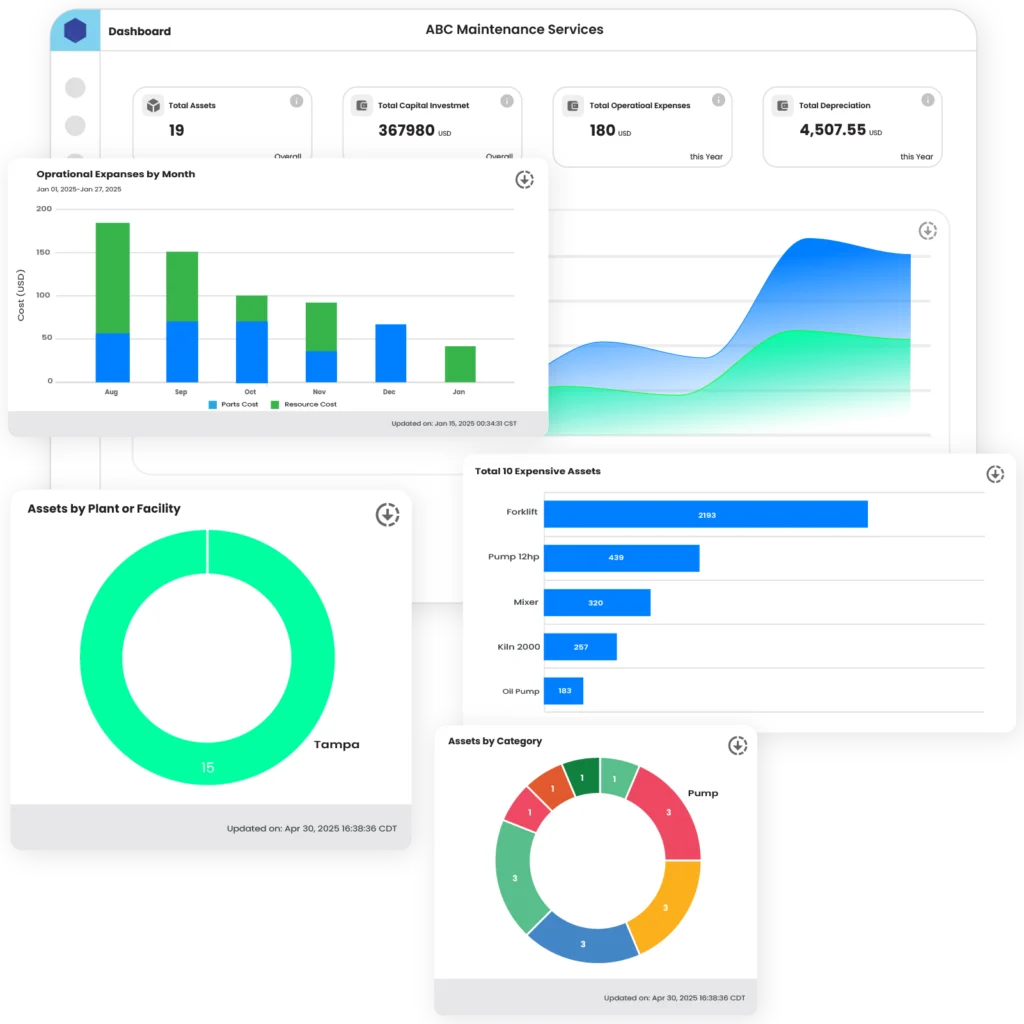
Fogwing EAM is a comprehensive enterprise asset management (EAM) software designed for asset-intensive industries, including construction and infrastructure.
It is positioned as an enterprise asset management platform rather than a basic tracking tool, making it more suitable for construction firms managing complex maintenance operations across multiple sites and regions.
Unlike basic tracking tools, Fogwing EAM focuses on the complete asset lifecycle from commissioning and maintenance to performance analysis and optimisation. It is well-suited for large construction firms operating across multiple sites and regions such as the Middle East, India, and APAC.
Best for:
Construction companies need scalable, maintenance-driven asset management with strong analytics.
Key capabilities
- Asset lifecycle management
- Preventive and predictive maintenance
- Work order and inspection management
- Asset performance and downtime analytics
- Multi-site and multi-region deployment
Pros
- Strong maintenance and reliability focus
- Scales well for large construction portfolios
- Good visibility across projects and regions
Cons
- Requires structured asset data setup initially
2. Asset Panda
Asset Panda is a cloud-based asset tracking platform commonly used for basic asset visibility and inventory-style management.
Best for:
Small to mid-sized construction teams need simple asset tracking.
Pros
- Easy to use
- Mobile-friendly interface
Cons
- Limited depth in maintenance management
- Not ideal for complex construction operations
3. ToolWatch
ToolWatch focuses heavily on tool tracking and inventory control in construction environments.
Best for:
Construction firms with high tool loss or tool-sharing challenges.
Pros
- Strong tool and inventory tracking
- Designed specifically for construction use
Cons
- Limited enterprise-level asset lifecycle management
4. Tenna
Tenna is widely used for equipment tracking and fleet visibility, especially for mixed-owned and rented assets.
Best for:
Construction companies manage large fleets across multiple sites.
Pros
- Good equipment tracking and telematics integration
- Useful utilisation insights
Cons
- Maintenance workflows may require integrations
How to Choose the Right Asset Management Software for Construction
Choosing the best asset management software for construction isn’t about features; it’s about operational fit.
Construction companies should ask:
- Can it handle multiple job sites and regions?
- Does it support preventive maintenance, not just tracking?
- Will site teams actually use it in the field?
- Can it scale as projects expand across regions like the Middle East or APAC?
- Does it provide insights into asset performance and cost?
The right system reduces downtime, improves asset utilisation, and keeps projects moving especially in high-growth construction markets.
Enterprise platforms such as Fogwing EAM typically meet these requirements for construction companies operating across multiple sites, offering integrated maintenance and asset lifecycle visibility.
The Shift from Asset Tracking to Asset Optimisation
In 2026, construction companies are moving beyond basic tracking.
Modern asset management platforms help organisations:
- Predict failures before they happen
- Reduce maintenance costs over time
- Improve equipment availability during critical phases
- Make data-driven decisions on repair vs replace
This shift from tracking assets to optimising asset performance is where enterprise-grade platforms like Fogwing EAM stand out.
Final Thoughts
Construction in 2026 demands tighter control over assets, maintenance, and costs—especially in fast-growing regions like the Middle East, India, and APAC.
The right asset management software helps construction companies move from reactive equipment management to proactive, data-driven operations.
Platforms such as Fogwing EAM are increasingly shaping how construction companies manage asset visibility, preventive maintenance, and multi-site coordination across regions like the Middle East, India, and APAC, enabling a shift from reactive equipment management to fully optimised asset operations.
FAQs
1. What is the best asset management software for construction in 2026?
The best solution depends on project size and asset complexity. Enterprise platforms like Fogwing EAM suit large construction firms, while tools like Asset Panda or ToolWatch work for simpler needs.
2. Is asset management software useful for rented construction equipment? ?
Yes. Modern systems track maintenance, usage, and costs for both owned and rented assets.
3. Can asset management software support multiple regions and sites?
Absolutely. Cloud-based platforms support construction operations across the Middle East, APAC, India, and other high-growth regions.
4. Does asset management software reduce construction downtime?
Yes. Preventive maintenance and real-time visibility significantly reduce unexpected equipment failures.