
How to Reduce Machine Downtime in Malaysian Manufacturing Plants
Improving Manufacturing Maintenance with CMMS Software
Practical strategies to improve equipment reliability, production uptime, and maintenance performance
Table of Contents
Malaysian manufacturers can reduce machine downtime by prioritizing critical equipment, improving preventive maintenance, keeping critical spare parts available, standardizing inspections, and investigating recurring failures. CMMS software helps maintenance teams coordinate assets, work orders, preventive maintenance schedules, and maintenance records in one system. For suitable critical equipment, Industrial IoT monitoring can provide additional condition data to help teams identify potential problems earlier.
For manufacturers in electronics, semiconductors, machinery and equipment, automotive, food processing, and other industrial sectors, the goal is not simply to repair machines faster. It is to prevent avoidable failures, shorten recovery time when breakdowns occur, and improve the availability of critical production equipment.
Malaysia’s manufacturing sector includes high-value industries such as electrical and electronics, alongside machinery and equipment manufacturing. As factories adopt automation and other Industry 4.0 technologies, reliable equipment and coordinated maintenance processes become increasingly important. For sector context, see MIDA’s electrical and electronics industry overview and machinery and equipment overview.
How can Malaysian manufacturers reduce machine downtime?
Manufacturers can reduce machine downtime by:
- Prioritizing machines that have the greatest impact on production.
- Creating preventive maintenance plans for individual assets.
- Managing maintenance tasks and work orders through a CMMS.
- Using consistent inspection procedures and digital checklists.
- Keeping critical spare parts available.
- Improving work order assignment and repair workflows.
- Tracking downtime, MTBF, MTTR, and preventive maintenance compliance.
- Monitoring critical equipment conditions with Industrial IoT where appropriate.
- Investigating recurring failures instead of repeatedly repairing the same problem.
- Reviewing maintenance data to improve reliability over time.
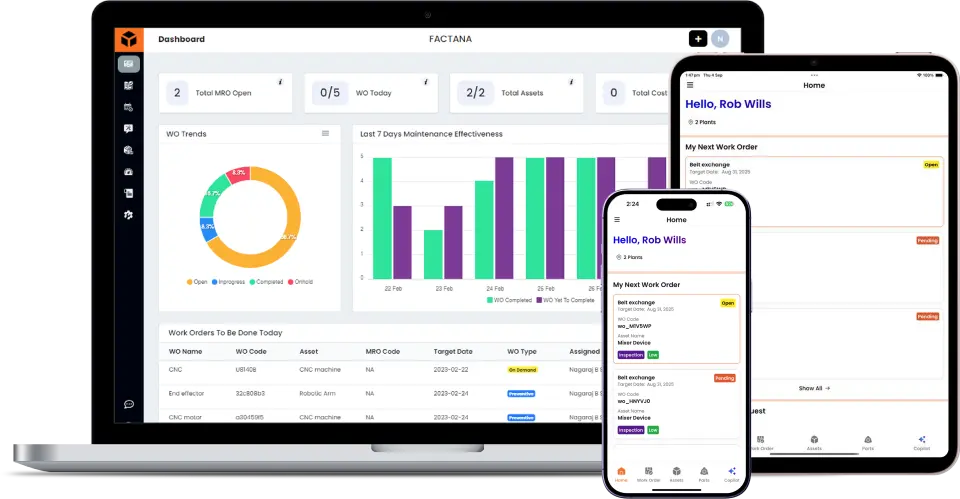
A CMMS such as Fogwing CMMS can help organize asset records, preventive maintenance, work orders, inspections, spare parts, and maintenance history in one workflow.
Why does machine downtime matter in Malaysian manufacturing?
When a critical machine stops, the effects can extend beyond the equipment itself. A breakdown may reduce output, disrupt production schedules, delay customer orders, increase overtime, and create bottlenecks for downstream processes.
This matters in environments with interconnected production equipment, including electronics and semiconductor manufacturing. In these settings, the failure of one important machine or supporting utility can affect other stages of production.
Instead of relying on spreadsheets, paper records, emails, or disconnected systems, maintenance teams can use a CMMS to organize their daily work and keep maintenance information connected to the assets it belongs to.
The value of CMMS becomes particularly important when manufacturers want to reduce unplanned downtime. By making maintenance activities more structured and giving teams better visibility into asset history, a CMMS can help organizations identify recurring problems, complete preventive maintenance on time, and respond faster when equipment issues occur.
Common consequences of downtime include:
- Lost production hours and reduced asset utilization
- Delayed orders and missed delivery commitments
- Higher emergency repair and overtime costs
- Unplanned spare parts consumption
- Production bottlenecks and potential quality issues
- A growing maintenance backlog
The actual impact depends on the asset, production process, available backup equipment, and length of the interruption. Manufacturers should therefore identify which machines create the greatest operational risk rather than treating every asset equally.
What causes machine downtime in manufacturing plants?
Before choosing solutions, maintenance teams need to understand the main causes of downtime at their own sites.
1. Overreliance on reactive maintenance
When teams mainly respond after equipment fails, technicians spend much of their time handling emergencies. The same problems may recur if the underlying causes are not investigated.
Reactive repairs are sometimes unavoidable, but relying on them as the primary maintenance approach makes downtime harder to control.
2. Missed preventive maintenance
Production pressure, emergency work, limited technician availability, poor scheduling, and manual reminders can cause maintenance tasks to be postponed. Delayed lubrication, inspections, calibration, or component replacement may allow equipment problems to develop.
3. Incomplete asset information
Without accurate asset records, technicians may lose time locating equipment details, maintenance instructions, failure history, or associated spare parts. A centralized asset register should include an asset ID, location, equipment type, manufacturer and model where available, criticality, maintenance requirements, and service history.
4. Inconsistent inspections
When technicians use different inspection methods, important signs of wear or abnormal operation may be missed. Standard procedures and checklists help teams check the same critical points consistently.
5. Unavailable spare parts
A repair can be delayed even after a fault has been diagnosed if a required bearing, seal, sensor, motor, filter, or electrical component is unavailable. Critical spare parts should be identified according to equipment risk, usage, and replenishment lead time.
6. Limited equipment-condition monitoring
Equipment can develop abnormal vibration, temperature, pressure, current draw, or energy consumption before a failure becomes obvious. Monitoring relevant parameters can help teams investigate changes earlier, particularly on critical assets.
7. Recurring failures that are not analyzed
Replacing a repeatedly failing bearing may restore operation temporarily without resolving the cause. Poor lubrication, misalignment, contamination, excessive load, incorrect installation, or unsuitable maintenance intervals may need investigation.
10 ways to reduce machine downtime in Malaysian manufacturing plants
1. Prioritize critical machines
Not every machine has the same effect on production. A failure in a bottleneck machine may stop an entire line, while a failure in an asset with a reliable backup may have a smaller impact.
Classify assets by factors such as:
- Production and downstream process impact
- Safety and environmental risk
- Product quality impact
- Failure frequency and repair cost
- Replacement lead time and availability of backup equipment
A practical classification is critical, high, medium, and low. Give critical assets greater attention when setting maintenance frequencies, planning spare parts, and deciding where condition monitoring is justified.
2. Create asset-specific preventive maintenance plans
A single maintenance schedule will not suit every machine. Define tasks and frequencies using manufacturer recommendations, operating conditions, runtime, production cycles, failure history, asset criticality, and known failure modes.
Depending on the equipment, tasks may include lubrication, cleaning, inspection, calibration, alignment, tightening, electrical checks, functional testing, or component replacement.
Review the plan when failure patterns or operating conditions change. The objective is to address predictable equipment risks without performing unnecessary maintenance.
3. Manage maintenance through a CMMS
Paper records and spreadsheets can become difficult to coordinate as the number of assets, technicians, work orders, and production lines increases.
A CMMS can connect:
Assets → Preventive maintenance → Work orders → Inspections → Spare parts → Maintenance history → Reporting
Maintenance teams can use it to schedule recurring tasks, assign technicians, prioritize work, record failures, track completion, maintain asset history, and review downtime trends.
Instead of relying on separate records to find out what needs attention, managers can work from a more centralized view of planned, overdue, active, and completed maintenance.

4. Standardize maintenance plans and inspections
For each critical asset, define the maintenance tasks, frequency, inspection points, required parts, responsible team, and completion record. Digital checklists can help technicians follow the same process and document findings.
For example, a compressor inspection may include pressure, temperature, oil level, vibration, leakage, filter condition, and unusual noise. The checklist should specify acceptable ranges where appropriate and explain what to do when a reading falls outside them.
A standardized process improves consistency and makes inspection history easier to review.
5. Keep critical spare parts available
Identify the components that could significantly extend downtime if they are unavailable. Monitor current stock, minimum stock levels, usage, replenishment lead times, and the assets that depend on each part.
For example, a critical pump may require bearings, seals, a coupling, and gaskets. Connecting parts information to maintenance plans can help teams prepare materials before scheduled work begins.
Stocking every component is not practical. Focus on parts whose unavailability presents a meaningful risk to production and whose procurement lead time is significant.
6. Improve work order management
Use a clear process for maintenance requests:
Request → Assessment → Priority → Assignment → Repair → Verification → Closure
A useful work order records the asset, reported problem, priority, assigned technician, planned and target dates, inspection checklist, parts required, work performed, failure information, and completion status.
Clear priorities and ownership help managers identify delays caused by assignment, approvals, diagnosis, parts availability, or repair work. Work orders also create records that can be analyzed for recurring problems.
7. Reduce mean time to repair (MTTR)
Preventing failures is important, but teams also need to restore equipment efficiently when breakdowns occur.
Repair time can be extended by slow diagnosis, unavailable technicians or tools, missing parts, unclear procedures, limited access to equipment history, and approval delays.
To reduce avoidable delays, provide technicians with relevant asset records, troubleshooting instructions, repair procedures, parts information, and previous work orders. Track MTTR over time and investigate assets with unusually long repair durations.
8. Monitor critical equipment with Industrial IoT
Preventive maintenance is planned around time or usage, but equipment problems do not always follow a schedule. For critical assets, Industrial IoT sensors and connected systems can monitor parameters such as vibration, temperature, pressure, motor current, energy consumption, runtime, or equipment status.
When a reading changes unexpectedly, maintenance teams can investigate and decide whether an inspection or work order is needed. Monitoring should be selected according to asset criticality, failure modes, sensor suitability, and the team’s ability to act on alerts.
This can help a maintenance program progress from reactive repairs toward preventive and condition-based maintenance. Predictive maintenance may be appropriate when sufficient reliable data and suitable analytical methods are available; it should not be assumed that sensors alone predict every failure.
9. Analyze recurring failures and perform root cause analysis
Maintenance records become more valuable when teams review them for patterns. Ask:
- Which assets cause the most unplanned downtime?
- Which components fail repeatedly?
- Are particular failure modes becoming more frequent?
- Which preventive maintenance tasks appear effective?
- Do maintenance intervals need to change?
- Which assets would benefit from condition monitoring?
For example, if a motor has experienced several bearing failures in a year, investigate lubrication, alignment, load, contamination, installation, operating conditions, and maintenance practices before simply repeating the replacement.
Root cause analysis should lead to corrective action and a check that the problem does not recur. AI-assisted analysis may help identify patterns in maintenance records, but findings should be reviewed against equipment knowledge and reliable data.
10. Review maintenance KPIs regularly
Use a consistent set of measures to determine whether downtime is improving. Review the trends by machine, production line, component, and failure mode, not just as a plant-wide total.
Useful measures or KPIs include total and unplanned downtime, mean time between failures (MTBF), mean time to repair (MTTR), preventive maintenance compliance, asset availability, repeat failure rate, and maintenance backlog.
Use these results to adjust maintenance plans, identify recurring bottlenecks, and decide where further investigation or monitoring is warranted.
How to measure machine downtime
A simple calculation is:
Downtime = Planned operating time − Actual operating time
For example, if a machine is scheduled to operate for 16 hours and operates for 14.5 hours, its downtime for that period is:
16 − 14.5 = 1.5 hours
Define the measurement rules consistently. Specify the reporting period and whether planned maintenance, scheduled breaks, changeovers, or other planned stops are included. Do not compare figures calculated using different definitions.
Track downtime by:
- Machine and production line
- Planned versus unplanned downtime
- Failure mode and component
- Duration and frequency of stoppages
- Estimated downtime cost, where reliable data is available
These breakdowns help teams find the assets and failure causes that contribute most to lost production time.
Maintenance KPIs manufacturers should track
| KPI | What it tells you | General improvement direction |
|---|---|---|
|
Unplanned downtime |
Time lost to unexpected interruptions |
Decrease |
|
MTBF |
Average operating time between failures |
Increase |
|
MTTR |
Average time to repair or restore equipment, according to the site’s definition |
Decrease |
|
PM compliance |
Proportion of scheduled preventive tasks completed within the defined period |
Increase |
|
Asset availability |
Proportion of the defined production time that equipment is available |
Increase |
|
Repeat failure rate |
How often the same asset or failure recurs |
Decrease |
|
Maintenance backlog |
Outstanding maintenance work |
Manage to a sustainable level |
Common calculation approaches include:
- MTBF = Total operating time ÷ Number of failures
- MTTR = Total repair time ÷ Number of repairs
- PM compliance = Scheduled PM tasks completed on time ÷ Scheduled PM tasks × 100
- Availability = Operating time ÷ Defined planned production time × 100, when this is the agreed site definition
Use consistent definitions across reports. Availability calculations can vary depending on whether the organization measures operational, inherent, or production availability, so document the method being used.
How CMMS software helps reduce machine downtime
A CMMS brings key maintenance processes together instead of keeping asset records, work orders, preventive maintenance schedules, inspection results, and spare parts information in disconnected systems.
A manufacturing CMMS can help teams:
- Manage assets: Keep equipment information, location, criticality, and service history organized.
- Schedule preventive maintenance: Plan recurring tasks and generate work orders.
- Coordinate work orders: Assign, prioritize, track, and close maintenance activities.
- Standardize inspections: Record checklist results and technician observations.
- Manage spare parts: Track stock, consumption, and parts associated with assets.
- Record downtime: Identify assets experiencing frequent or extended interruptions.
- Review reliability: Monitor MTBF, MTTR, preventive maintenance compliance, and recurring failures.
The value of CMMS software goes beyond replacing paper work orders. It helps connect maintenance planning, execution, recordkeeping, and performance review in a consistent workflow.
Plan → Execute → Record → Analyze → Improve
For manufacturing teams, this connected process can make it easier to track overdue preventive maintenance, review equipment history, coordinate repair activities, and investigate recurring failures. The actual results depend on data quality, maintenance practices, implementation, and how consistently teams use the system.
How Fogwing CMMS can support Malaysian manufacturers
Fogwing CMMS helps manufacturing maintenance teams organize asset information, preventive maintenance schedules, work orders, inspections, spare parts, and maintenance history. These capabilities support a more structured approach to maintenance planning and help teams investigate recurring equipment problems.
For Malaysian manufacturers managing multiple machines or production lines, Fogwing CMMS can help coordinate maintenance activities through a centralized workflow. Teams can organize equipment records, schedule preventive maintenance, assign work orders, document inspections and repairs, and review available maintenance records to identify recurring issues.
For critical equipment, manufacturers can also evaluate whether supported Industrial IoT integrations can provide additional condition information for maintenance decisions. The suitability of these capabilities depends on the equipment, integration requirements, and available product configuration.
Manufacturers looking to organize their maintenance operations can explore Fogwing CMMS to understand how its available capabilities align with their plant’s maintenance requirements.
5 Steps to Reduce Manufacturing Downtime in Malaysia
Malaysian manufacturing plants do not need to change every maintenance process at once. A practical starting plan is:
Step 1: Prioritize Critical Equipment
Use downtime records, production impact, safety considerations, and failure frequency to prioritize equipment.
Step 2: Identify Recurring Failure Causes
Review downtime records and maintenance history to identify equipment that repeatedly interrupts production. Investigate the underlying causes and document corrective actions to prevent similar failures.
Step 3: Improve Preventive Maintenance
Review maintenance schedules, inspection procedures, and spare parts requirements according to equipment specifications, operating conditions, and failure history. Adjust maintenance plans when recurring problems or operating conditions indicate a need for improvement.
Step 4: Organize Maintenance Activities
Use a consistent workflow or computerized maintenance management system (CMMS) to coordinate asset records, preventive maintenance, work orders, inspections, and spare parts information. This helps maintenance teams manage planned work and track outstanding tasks.
Step 5: Measure Results and Improve
Monitor downtime, mean time between failures (MTBF), mean time to repair (MTTR), and preventive maintenance compliance. Review these indicators regularly to identify recurring problems and determine whether maintenance improvements are delivering the intended results.
Machine Downtime Reduction Checklist for Malaysian Manufacturers
Use this checklist to assess your current maintenance process:
Identify and prioritize critical production equipment.
Record downtime consistently by asset and failure cause.
Review preventive maintenance schedules regularly.
Ensure critical spare parts are available when needed.
Document maintenance work orders, inspections, and repairs.
Monitor MTBF, MTTR, and preventive maintenance compliance.
Investigate recurring failures and review corrective actions.
A CMMS can help maintenance teams coordinate these activities and maintain consistent equipment records.
Common Mistakes to Avoid When Reducing Manufacturing Downtime
Manufacturers can reduce machine downtime by identifying failure causes, prioritizing critical assets, and improving maintenance planning. Avoid these common mistakes to improve equipment reliability and maintenance efficiency.
Relying Only on Emergency Repairs:
Repeated breakdowns require root cause analysis and corrective action, not just quick repairs.
Treating All Assets Equally:
Prioritize maintenance based on equipment criticality, production impact, safety risks, and failure history.
Tracking Downtime Without Finding Causes:
Record failure reasons alongside downtime duration to identify recurring problems and prevent future breakdowns.
Ignoring Spare Parts Availability:
Monitor critical spare parts and maintain appropriate stock levels to avoid repair delays.
Increasing Preventive Maintenance Without Reviewing Results:
Evaluate maintenance schedules, PM compliance, and recurring failures to ensure tasks address actual equipment risks.
Keeping Maintenance Records Disconnected:
Use a computerized maintenance management system (CMMS) to centralize asset records, work orders, inspections, and spare parts information.
Avoiding these mistakes helps manufacturers reduce recurring failures, improve equipment availability, and build a more effective maintenance strategy.
Final Thoughts
Reducing machine downtime in Malaysian manufacturing plants requires a combination of preventive maintenance, critical asset prioritization, spare parts planning, consistent inspections, and root cause analysis. Tracking downtime, MTBF, MTTR, and preventive maintenance compliance helps teams identify recurring problems and measure improvement.
CMMS software can help manufacturers coordinate asset records, maintenance schedules, work orders, inspections, spare parts, and maintenance history. When combined with suitable Industrial IoT monitoring, it can also support more informed maintenance decisions for critical equipment.
For manufacturers looking to organize their maintenance operations and improve asset reliability, Fogwing CMMS offers a maintenance management platform worth evaluating against their operational needs.

FAQs on Reducing Machine Downtime in Malaysian Manufacturing Plants
1. How can Malaysian manufacturers reduce machine downtime?
Malaysian manufacturers can reduce machine downtime by prioritizing critical equipment, improving preventive maintenance, managing spare parts, tracking downtime causes, and investigating recurring failures. A CMMS helps coordinate maintenance activities and maintain consistent equipment records.
2. What are the common causes of machine downtime in manufacturing?
Common causes include equipment breakdowns, missed preventive maintenance, electrical faults, poor lubrication, worn components, unavailable spare parts, and recurring failures. Identifying root causes helps prevent repeated production interruptions.
3. How does preventive maintenance reduce manufacturing downtime?
Preventive maintenance reduces unexpected breakdowns through scheduled inspections, servicing, lubrication, and component replacement. Schedules should reflect equipment condition, failure history, operating requirements, and manufacturer recommendations.
4. How does CMMS software help reduce machine downtime?
CMMS software centralizes asset records, preventive maintenance schedules, work orders, inspections, spare parts information, and maintenance history. This helps teams plan repairs, coordinate tasks, investigate recurring failures, and monitor maintenance performance.
5. How can Fogwing CMMS help Malaysian manufacturers reduce machine downtime?
Fogwing CMMS helps manufacturing maintenance teams organize asset information, schedule preventive maintenance, manage work orders and inspections, track spare parts, and maintain equipment service history. These capabilities can support more coordinated maintenance activities and help teams investigate recurring equipment problems. Manufacturers should evaluate the available features and integrations against their specific maintenance requirements.