
Best Quality Inspection Software for Automotive Parts Manufacturing
Choosing the Right
Quality Inspection Software for Automotive Parts Manufacturing
A Buyer’s Guide to find the best Quality Inspection Software for Automotive Parts Manufacturing
Table of Contents
Quality inspection software has become mission-critical for automotive parts manufacturers producing engine components, braking systems, transmission parts, castings, forgings, and precision-machined assemblies.
As production volumes increase and tolerance limits tighten, manufacturers can no longer depend on manual inspection sheets, sampling-based quality checks, or disconnected spreadsheets. These traditional methods struggle to keep up with high-speed production lines and often allow defects to be detected too late after rework, customer complaints, or costly recalls.
That’s why automotive manufacturers are increasingly adopting automated quality inspection software and AI-powered visual inspection systems that enable in-line defect detection, standardised inspections, and end-to-end traceability across the production lifecycle.
In 2026, the best quality inspection software for automotive parts manufacturing must do more than log defects. It must operate at production speed, capture visual evidence, integrate with MES and ERP systems, and support audit-ready quality documentation—without disrupting shop-floor operations.
This buyer’s guide helps automotive manufacturers evaluate leading quality inspection software platforms based on real shop-floor requirements, not marketing claims.
Why Quality Inspection Software Is Essential for Automotive Parts Manufacturing
Automotive quality requirements are unforgiving. OEMs and Tier-1 suppliers demand zero-defect deliveries, full traceability, and immediate corrective action when deviations occur.
At the same time, production lines are becoming faster and more automated. Manual inspection processes simply cannot scale resulting in inconsistent checks, subjective judgement, delayed reporting, and quality escapes.
Modern automotive quality inspection software helps manufacturers:
- Detect defects during production, not after shipment
- Standardise inspection criteria across shifts, lines, and plants
- Reduce reliance on subjective manual judgement
- Maintain digital inspection records for IATF 16949 and customer audits
- Enable faster root-cause analysis and corrective action
Manufacturers adopting automated and AI-enabled inspection systems often report 30–35% defect reduction, primarily because inspections become real-time, consistent, and data-driven rather than reactive.
What Is Quality Inspection Software and How Does It Work?
Quality inspection software is a digital platform used to inspect, verify, and document part quality throughout the automotive production process. It replaces paper checklists and spreadsheets with connected, standardised inspection workflows.
Inspection points are defined across the production line, and each part is checked against predefined quality criteria. Inspections may be performed manually by operators or automatically using AI-based visual inspection software powered by industrial cameras.
When a defect is detected, it is recorded instantly, often with image or video evidence, and linked to the relevant part number, batch, machine, shift, or operator. This gives quality teams immediate visibility and allows corrective action before defects move downstream.
Over time, the system builds a complete digital quality history, helping manufacturers identify recurring issues, stabilise processes, and reduce rework and warranty claims.
In practical terms, quality inspection software helps automotive plants inspect faster, act sooner, and maintain consistent quality at scale.
What Quality Inspection Software Does on the Automotive Shop Floor
On the shop floor, quality inspection software acts as the digital backbone of quality control.
Instead of fragmented inspection records, all inspection activities are centralised into a single system that connects operators, machines, and quality data.
Typical shop-floor capabilities include:
- In-line visual and dimensional inspection
- Digital capture of defects with image or video evidence
- Inspection results linked to part numbers, batches, and machines
- Real-time dashboards for supervisors and quality engineers
- Centralised audit trails for compliance and customer reviews
The outcome is not just better inspection but faster decisions, clearer accountability, and fewer quality surprises.
Common Automotive Quality Inspection Use Cases
Leading automotive manufacturers deploy quality inspection software across multiple scenarios, including:
- Surface defect detection on castings and forgings
- Scratch, dent, and burr inspection on machined parts
- Assembly verification for sub-assemblies and components
- Weld quality and joint inspection
- Dimensional and tolerance compliance checks
- Visual verification before packing and dispatch
These use cases highlight why AI-enabled and visual inspection software is increasingly preferred over manual inspection methods.
A Closer Look at the Best Quality Inspection Software for Automotive Parts Manufacturing
1. Fogwing Vision
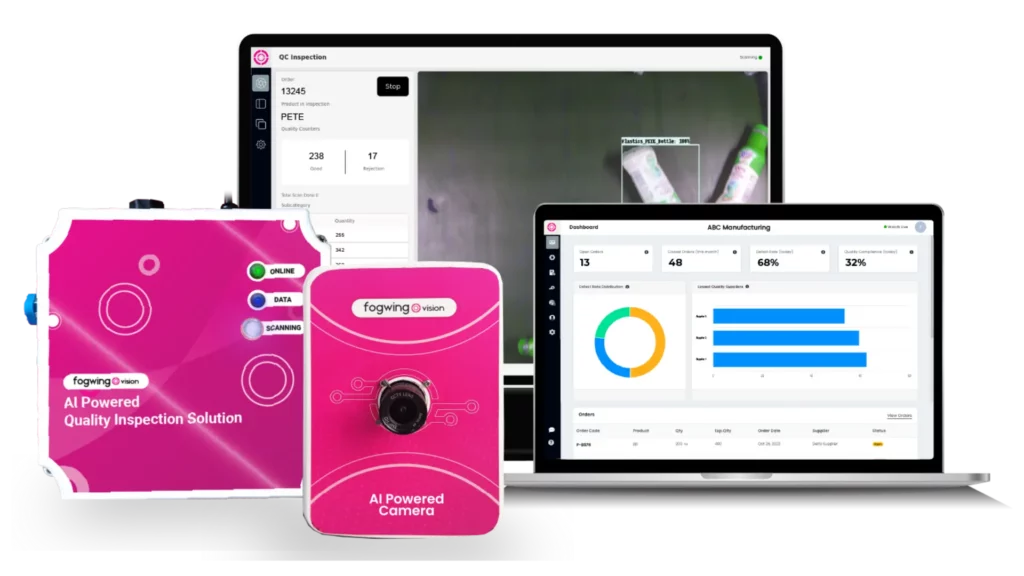
Fogwing Vision is an end-to-end AI-powered visual inspection software platform designed for automotive production lines. It combines automated defect detection, real-time dashboards, and production-linked traceability in a single system.
Unlike standalone vision engines, Fogwing Vision focuses on complete inspection workflows from detection to analysis and corrective action while minimising dependency on specialised vision engineers. It supports both automated and operator-assisted inspections, making it suitable for mixed production environments.
Best for:
Automotive manufacturers looking for a production-ready, AI-driven inspection system that deploys quickly and scales across lines and plants.
Key capabilities
- AI-based visual defect detection
- Image and video-based inspection evidence
- Real-time quality dashboards
- MES and ERP integration
- Multi-line and multi-plant scalability
Pros
- Strong shop-floor usability
- Faster deployment compared to custom vision systems
- Clear real-time visibility for quality teams
Cons
- Initial AI model tuning required for complex defect scenarios
2. Cognex ViDi
Cognex ViDi is a deep learning machine vision software used to solve complex inspection problems that traditional rule-based systems cannot handle. It is typically deployed alongside Cognex cameras and vision hardware.
While ViDi excels at image analysis, it functions primarily as a vision engine, not a complete quality inspection management platform. Inspection results often require integration with external MES or quality systems for reporting and traceability.
Best for:
Manufacturers with complex visual inspection needs and in-house vision engineering expertise.
Pros
- High accuracy for challenging visual defects
- Mature and widely adopted vision ecosystem
Cons
- Requires specialist configuration
- Limited built-in quality workflows and dashboards
3. ATS Inspect
ATS Inspect positions itself as a quality inspection and assurance platform rather than a pure vision tool. It focuses on inspection of workflows, audits, root-cause analysis, and corrective action management.
It is commonly used alongside external vision systems to consolidate inspection data and support enterprise-level quality governance.
Best for:
Manufacturers prioritise audits, compliance, and corrective action workflows.
Pros
- Strong quality governance and audit support
- Good visibility for quality leadership
Cons
- Limited native AI-based visual inspection
- Often paired with third-party vision solutions
Quick Comparison :
Sometimes you just need to see it all laid out. Here’s a quick comparison to help you weigh them up.
| Aspect | Fogwing Vision | Cognex ViDi | ATS Inspect |
|---|---|---|---|
|
Inspection focus |
AI-driven end-to-end inspection |
Deep learning vision engine |
Quality workflows & governance |
|
Shop-floor usability |
High |
Moderate |
High |
|
Built-in dashboards |
Strong |
Limited |
Strong |
|
MES / ERP integration |
Strong |
Custom |
Strong |
|
Best suited for |
Production-ready inspection |
Complex vision tasks |
Process-driven quality teams |
How to Choose the Right Quality Inspection Software
Choosing the best quality inspection software for automotive parts manufacturing is about operational fit, not feature lists.
Automotive manufacturers should ask:
- Can it detect defects reliably at our production speed?
- Will operators actually use it on the shop floor?
- Does it integrate with our MES or ERP systems?
- Can it scale across multiple lines or plants?
- Will it simplify audits rather than complicate them?
Factories using AI-enabled inspection tools often report 50–60% faster inspection cycles, simply because data capture and decision-making become instantaneous.
The Shift from Inspection to Prevention
The future of automotive quality inspection is not just about detecting defects, it’s about preventing them.
Modern platforms are increasingly used to:
- Identify recurring defect patterns
- Link defects to machines, tools, or shifts
- Trigger corrective actions automatically
- Feed quality insights back into process improvement
This is where advanced platforms like Fogwing Vision move beyond inspection and actively support continuous quality improvement.
Final Thoughts
For automotive parts manufacturers, quality inspection is no longer a final checkpoint—it is a core production capability.
As production speeds increase and quality requirements tighten, manual inspections and disconnected vision tools struggle to deliver consistent, real-time results. The best quality inspection software for automotive parts manufacturing enables in-line defect detection, digital traceability, and faster corrective action, without disrupting shop-floor operations.
The right solution is not defined by features alone, but by how well it fits real factory workflows. Platforms that combine AI-based inspection, operator usability, and seamless MES/ERP integration help manufacturers shift from reactive inspection to proactive defect prevention.
In 2026, quality is not just inspected at the end of the line. It is engineered into the process, and the right inspection software makes that possible.
FAQs
1. What is the difference between quality inspection software and vision systems?
Vision systems focus on image analysis, while quality inspection software manages the entire inspection workflow, traceability, reporting, and corrective actions.
2. Can quality inspection software work with existing cameras and machines?
Yes. Most modern platforms integrate with existing cameras, PLCs, MES, and ERP systems.
3. Is AI-based inspection suitable for high-volume automotive production?
Absolutely. AI-enabled inspection is specifically designed to operate at production speed and handle variability in high-volume environments
4. What is the best quality inspection software for automotive parts manufacturing in 2026?
The best quality inspection software for automotive parts manufacturing in 2026 includes Fogwing Vision, Cognex ViDi, and ATS Inspect.
Fogwing Vision offers an end-to-end, AI-powered inspection platform with real-time dashboards, traceability, and MES/ERP integration.
Cognex ViDi excels in complex visual defect detection but requires additional systems for workflows and reporting.
ATS Inspect focuses on quality audits, compliance, and corrective action management, often paired with external vision tools.
For most automotive manufacturers, the best solution balances AI inspection accuracy, shop-floor usability, and scalable quality workflows.