
Best Asset Management Software for Refineries
Asset Management Software in Refineries
A Practical Guide to Choosing the Right Asset Management Software for Modern Refinery Operations
Table of Contents
Refineries in 2026 operate under relentless pressure. From rising energy costs and tighter safety regulations to ageing equipment and unplanned shutdown risks, refinery operations today are far more complex than they were even a decade ago. Across regions like the Middle East, India, and APAC, refineries are expected to deliver maximum uptime, strict compliance, and operational efficiency all at once.
Yet one challenge remains universal across refineries worldwide Poor visibility and control over critical assets.
Pumps, compressors, turbines, heat exchangers, pipelines, and rotating equipment run continuously under harsh conditions. When asset data is fragmented across spreadsheets, legacy systems, or disconnected maintenance tools, refineries face frequent breakdowns, safety risks, and escalating maintenance costs.
This is where asset management software for refineries becomes mission-critical, not as a support system, but as a core operational backbone.
This 2026 buyer’s guide helps refinery leaders understand what modern asset management software should deliver and how to choose the right platform based on real operational needs, not vendor hype.
Why Asset Management Software Is Essential for Refineries in 2026
Refinery assets are expensive, asset-intensive, and failure-prone if not managed proactively. A single unplanned shutdown can cost millions in lost production, safety exposure, and regulatory scrutiny.
Traditional approaches, manual logs, reactive maintenance, and siloed CMMS tools can no longer handle:
- Continuous operations with zero tolerance for downtime
- Complex preventive and predictive maintenance schedules
- Safety, audit, and regulatory compliance requirements
- Multi-unit and multi-site refinery operations
- Rising spare parts, labour, and energy costs
Modern asset management software for refineries enables organisations to:
- Track critical equipment performance in real time
- Reduce unplanned downtime through preventive maintenance
- Extend asset life and optimise replacement decisions
- Control maintenance costs and spare inventory
- Maintain audit-ready safety and compliance records
For refineries operating across the Middle East, India, and APAC, asset management software is no longer optional,it’s foundational to safe and profitable operations.
What Is Asset Management Software for Refineries?
Asset management software for refineries is a digital platform that helps oil and gas operators track, maintain, and optimise physical assets throughout their lifecycle.
Typical refinery assets include:
- Pumps, compressors, turbines, and motors
- Heat exchangers, boilers, and pressure vessels
- Pipelines, valves, and storage tanks
- Utilities and auxiliary equipment
- Safety-critical and compliance-driven assets
The software centralises asset data, maintenance schedules, work orders, inspection records, and performance history, giving operations, maintenance, and reliability teams real-time visibility.
In simple terms, It helps refineries know what assets they have, how they’re performing, and what actions are needed to keep them running safely.
What Asset Management Software Does Inside a Refinery
Inside active refinery operations, asset management software acts as the single source of truth for maintenance and reliability teams.
Common capabilities include:
- Asset lifecycle management from commissioning to retirement
- Preventive and predictive maintenance scheduling
- Work order and permit-to-work management
- Digital inspections and safety checks
- Downtime, failure, and reliability tracking
- Maintenance cost and asset performance analytics
For refineries running 24/7 operations, this translates into fewer surprises, faster decisions, and better risk control.
Common Use Cases in Refinery Operations
Leading refineries use asset management software to:
- Prevent failures in rotating and critical equipment
- Schedule condition-based and preventive maintenance
- Track maintenance history for compliance audits
- Improve mean time between failures (MTBF)
- Reduce emergency shutdowns and reactive repairs
- Make data-driven repair vs replace decisions
These use cases are especially critical in large-scale refineries across oil-producing and refining hubs worldwide.
A Quick Snapshot of the Best Asset Management Software for Refineries (2026)
- Fogwing EAM – Enterprise-grade asset management software with strong preventive maintenance, reliability focus, and multi-site visibility; ideal for refineries across the Middle East, India, and APAC.
- IBM Maximo – Mature EAM platform widely used in asset-intensive industries, including oil and gas, with strong maintenance and reliability capabilities.
- SAP Asset Management – Deeply integrated asset management solution within SAP ecosystems, suited for refineries running SAP-based enterprise operations.
- AVEVA Enterprise Asset Management – Asset-centric platform designed for industrial and process-driven environments with advanced engineering and operational alignment.
Now, let’s look at these refinery asset management solutions more closely.
A Closer Look at Leading Asset Management Software for Refineries
When evaluating asset management software in 2026, refinery operators typically compare platforms based on maintenance depth, reliability focus, scalability, and operational usability.
1. Fogwing EAM
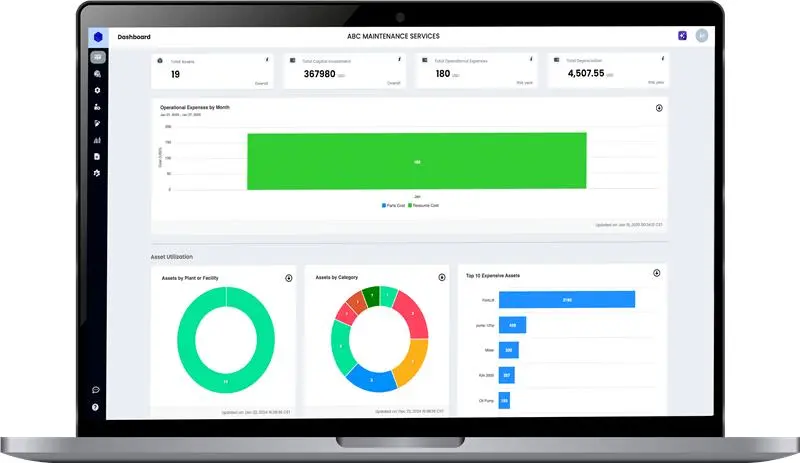
Fogwing EAM is a comprehensive enterprise asset management (EAM) software designed for asset-intensive industries such as oil & gas, refineries, and process manufacturing.
Unlike basic CMMS tools, Fogwing EAM focuses on full asset lifecycle management, preventive maintenance, and performance optimisation, making it suitable for large, multi-unit refinery operations.
Best for:
Refineries needing scalable, maintenance-driven asset management with strong analytics and multi-site visibility.
Key capabilities:
- Asset lifecycle and reliability management
- Preventive and predictive maintenance
- Work order and inspection management
- Downtime, failure, and cost analytics
- Multi-site and multi-region deployment
Pros:
- Strong focus on reliability and uptime
- Scales well for large refinery operations
- Good visibility across units and locations
Cons:
- Requires structured asset data setup initially
2. IBM Maximo
IBM Maximo is one of the most established EAM platforms used across oil and gas, utilities, and heavy industries.
Best for:
Large refineries with mature maintenance processes and dedicated IT support.
Pros:
- Robust maintenance and reliability features
- Widely adopted in asset-intensive industries
Cons:
- Implementation and configuration can be complex
- Higher total cost of ownership
3. SAP Asset Management
SAP Asset Management is part of the broader SAP ecosystem and integrates deeply with SAP ERP and finance modules.
Best for:
Refineries already operating heavily on SAP systems.
Pros:
- Strong enterprise integration
- Suitable for compliance-heavy environments
Cons:
- Less flexible outside SAP ecosystems
- User experience may be complex for field teams
4. AVEVA Enterprise Asset Management
AVEVA EAM focuses on engineering-driven and process-centric asset environments.
Best for:
Refineries require tight alignment between engineering data and asset operations.
Pros:
- Strong industrial and engineering focus
- Suitable for complex process assets
Cons:
- May require integrations for broader maintenance workflows
How to Choose the Right Asset Management Software for Refineries
Choosing the best asset management software for refineries isn’t about feature checklists; it’s about operational fit.
Refinery leaders should ask:
- Can it support continuous, 24/7 operations?
- Does it enable preventive and predictive maintenance?
- Can it manage safety-critical and compliance-driven assets?
- Will maintenance and field teams actually use it?
- Can it scale across multiple refinery units and regions?
- Does it provide insights into asset reliability and cost?
The right system reduces downtime, improves safety, and protects production output.
The Shift from Asset Tracking to Asset Optimisation in Refineries
In 2026, refineries are moving beyond basic asset tracking.
Modern asset management platforms help organisations:
- Predict failures before they impact production
- Reduce maintenance and energy costs over time
- Improve asset availability during peak demand
- Optimise lifecycle decisions based on data
This shift from tracking assets to optimising asset performance is where enterprise-grade solutions truly deliver value.
Final Thoughts
Refineries in 2026 demand tighter control over assets, maintenance, safety, and costs especially in energy-intensive and regulation-heavy environments.
The right asset management software helps refineries move from reactive maintenance to proactive, reliability-driven operations. Platforms like Fogwing EAM, alongside established enterprise solutions such as IBM Maximo, SAP Asset Management, and AVEVA, show how asset management can scale across units, sites, and regions without adding operational complexity.
In modern refinery operations, assets don’t just support production, they define how safely, efficiently, and profitably refineries operate.
FAQs
1. What is the best asset management software for refineries in 2026?
The best solution depends on refinery size and operational complexity. Enterprise platforms like Fogwing EAM, IBM Maximo, SAP Asset Management, and AVEVA EAM are commonly used in large refinery environments.
2. Can asset management software reduce unplanned refinery shutdowns?
Yes. Preventive and predictive maintenance capabilities significantly reduce unexpected equipment failures and shutdowns.
3. Is asset management software suitable for multi-site refinery operations?
Absolutely. Modern cloud-based EAM platforms support multi-unit and multi-region refinery operations with centralised visibility.
4. Does asset management software help with refinery compliance?
Yes. Digital inspections, maintenance logs, and audit-ready records help refineries meet safety and regulatory requirements.